with Holistic and Personalized Care at Its Children’s Center to Help Every Child Reach Their Full Potential

Bumrungrad International Hospital highlights growing concerns over emerging child health challenges and advances its Children’s Center with a holistic, personalized approach to pediatric care. The comprehensive approach addresses physical health, growth, development, and mental well-being, integrating the expertise of specialized physicians and multidisciplinary healthcare professionals to support every child in achieving age-appropriate growth and reaching their full potential. This commitment to excellence is further underscored by the hospital’s recognition among the world’s and Asia-Pacific’s leading hospitals specializing in pediatrics.
Artirat Charukitpipat, Ph.D., Chief Executive Officer of Bumrungrad International Hospital, stated at the press conference titled “Ask Questions About Your Child: Kids Grow at Their Own Pace,” held on 23rd November 2026, that child healthcare is becoming increasingly complex and challenging. This is particularly evident in areas such as child development, learning, behavior, emotional well-being, and mental health, amid changing lifestyles, increased digital media use, and growing academic expectations.
According to the World Health Organization (WHO), approximately 400 million children and adolescents aged 5–19 worldwide were overweight in 2024, including 170 million who were living with obesity. Meanwhile, approximately 1 in 7 adolescents aged 10–19 experienced mental health conditions. In Thailand, the Department of Health, Ministry of Public Health, reported that in 2024, more than 500,000 children aged 6–14 and over 200,000 adolescents aged 15–18 were overweight or living with obesity. Meanwhile, findings from the 7th Thai National Health Examination Survey (NHES VII), conducted in 2024–2025 with support from the Health Systems Research Institute (HSRI), indicated that approximately one in five children aged 10–14, or around 750,000 children, were at risk of depression.
“Child healthcare should go beyond treating illnesses to encompass physical health, development, behavior, and mental well-being. It is essential to recognize the individual differences and needs of each child, enabling them to enjoy a good quality of life and reach their full potential,” said Dr. Artirat.
Bumrungrad International Hospital has also been recognized by Newsweek magazine in the pediatrics category, ranking among the World’s Best Specialized Hospitals 2027 at No. 223 out of 250 hospitals. It is the only hospital in Thailand to receive this distinction. In addition, the hospital ranked No. 31 out of 125 hospitals in the Best Specialized Hospitals Asia Pacific 2026, retaining its position as Thailand’s No. 1 hospital in this category for the fourth consecutive year.
Preecha Laohakunakorn, M.D., Director of the Children’s Center and Specialist in General Pediatrics and Pediatric Cardiology at Bumrungrad International Hospital, said that the Children’s Center at Bumrungrad International Hospital provides comprehensive healthcare services for children from birth through 18 years of age. Services include routine health checkups, vaccinations, developmental assessments, diagnosis and treatment of conditions ranging from common illnesses to complex diseases, as well as long-term health monitoring. Care is delivered by a multidisciplinary team of pediatric subspecialists covering endocrinology, allergy and immunology, pulmonology, cardiology, neurology, gastroenterology, oncology and hematology, rheumatology, nephrology, dermatology, genetics, developmental and behavioral pediatrics, and child and adolescent psychiatry. The team also works closely with other healthcare professionals, including specialized pediatric nurses, pharmacists, nutritionists, physical therapists, and occupational therapists, to develop individualized care plans tailored to each child’s needs.
Cindy Chamrernnusit, M.D., Specialist in General Pediatrics and Developmental & Behavioral Pediatrics at Bumrungrad International Hospital, explained that assessing a child’s development requires evaluating multiple areas, including motor skills, cognitive abilities, learning, language, behavior, and social interaction. Both IQ and EQ should be nurtured in parallel. Key factors influencing child development include screen time, family relationships, sleep, and nutrition. Excessive screen time, in particular, may limit opportunities for learning and interaction with others. Parents should monitor their children’s development according to age-specific milestones and watch for potential warning signs, such as lack of eye contact, failure to respond when called by name, delayed speech, delayed walking, or difficulty maintaining attention. If developmental delays or regression are observed, parents should consult a physician to identify the underlying causes and develop a comprehensive care plan. Depending on each child’s needs, specialized developmental activities and facilities, such as a Snoezelen Room, may also be incorporated to provide sensory stimulation.
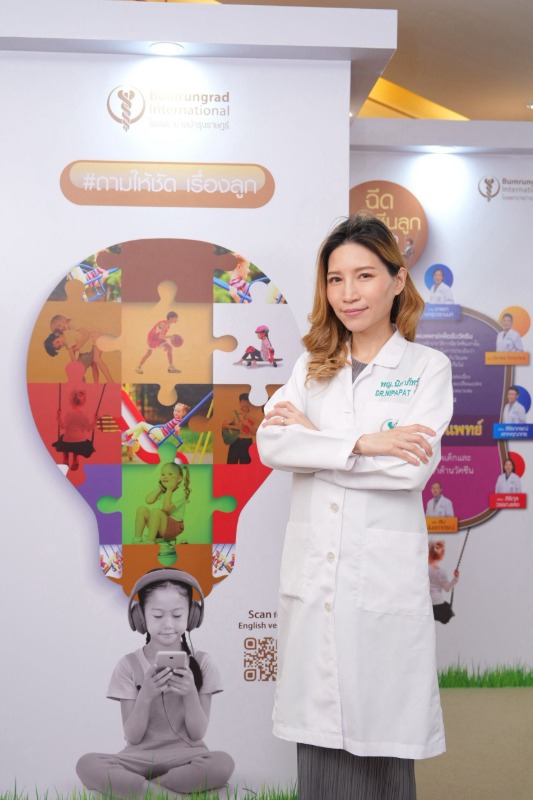
Nipapat Visavachaipan, M.D., Specialist in General Pediatrics and Pediatric Endocrinology & Metabolism at Bumrungrad International Hospital, explained that one of the more common child health concerns today is precocious puberty. Key warning signs include breast development in girls before the age of 8 or testicular enlargement in boys before the age of 9. Other signs may include unusually rapid physical changes, such as accelerated height gain, acne, or body odor resembling that of adolescents. Precocious puberty may initially cause children to grow taller at a faster rate. However, sex hormones accelerate bone maturation, causing growth plates to close earlier than normal. As a result, their adult height may fall short of their genetic growth potential. The condition may also affect children’s emotional well-being and self-confidence. Assessment therefore requires evaluating both physical growth and sexual development, along with other relevant factors, including family history and coexisting medical conditions. Investigations may include a hand X-ray to assess bone age, blood tests to measure sex hormone levels, and brain MRI in certain cases. Some children may require treatment with gonadotropin-releasing hormone (GnRH) agonists to suppress premature hormonal activity and help preserve their genetic growth potential. In addition, overweight and obesity may be associated with earlier pubertal onset in some children, particularly girls, and may increase the risk of long-term health problems. Appropriate attention should therefore be given to nutrition, sleep, and physical activity, without placing undue pressure on children or stigmatizing them because of their body shape or weight.
Pantri Kirdchok, M.D., Specialist in General Pediatrics and Child & Adolescent Psychiatry at Bumrungrad International Hospital, explained that mental health concerns among children and adolescents encompass developmental, behavioral, emotional, and interpersonal issues. Contributing factors may include family and school environments, peer relationships, early physical changes associated with precocious puberty, bullying both in person and online (cyberbullying), and the use of social media and online gaming when these interfere with daily life. Risk-taking behaviors, such as substance use and online gambling, may also affect children’s self-confidence and mental well-being. These challenges may manifest as stress, anxiety, depression, irritability, aggression, or physical symptoms such as headaches and abdominal pain without an identifiable cause. Other warning signs include social withdrawal or reluctance to attend school. If symptoms persist or begin to interfere with daily life, parents are encouraged to consult a child psychiatrist at an early stage. A formal psychiatric diagnosis is not required before seeking professional advice. Care may involve comprehensive assessment, counseling, psychotherapy, and medication when clinically indicated, alongside collaboration among families, schools, and the hospital.
At the heart of child healthcare is an understanding that every child is unique. Rather than rushing or comparing children’s growth and development with others, the focus should be on nurturing physical health, development, learning, and mental well-being together. This holistic approach helps children grow up healthy, enjoy a good quality of life, and reach their full potential.