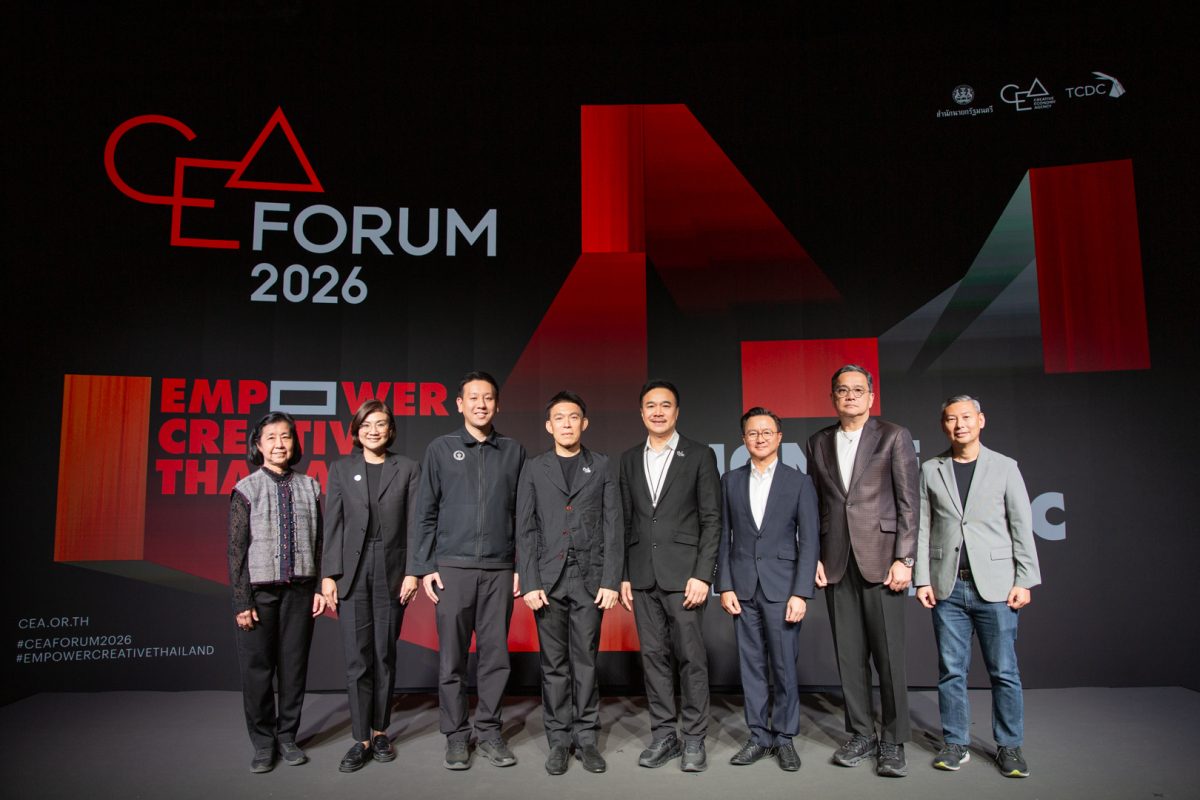
The Creative Economy Agency (Public Organization) or CEA organized “CEA Forum 2026” to unveil its vision and strategies for driving Thailand’s creative economy in 2026. The forum also featured panel discussions with government agencies and entrepreneurs under the theme “Empower Creative Thailand, Ignite Economic Impact”. According to CEA, its target creative industries (content, music, advertising, architecture, and design) are Thailand’s new economic engines that will generate new revenue streams. CEA has prepared comprehensive plans to develop creative entrepreneurs and professionals, spanning from the community level to industrial-scale production. Capacity-building infrastructure development will go ahead with the upcoming launch of New TCDC” centers across 20 provinces in Thailand. “City branding,” meanwhile, will be propelled via “Neramyth – Creative City & Place Branding.” To bring Thai music to the global market, CEA will implement “Music Exchange 2026” and “Thailand International Content IP Expo (TICIP)”which will be Thailand’s first dedicated international marketplace for content project trading. CEA’s goals for 2026 are to produce more than 300,000 creative entrepreneurs and professionals, drive the creation of more than 350 new commercial intellectual property (IP) works, and help raise the Gross Value Added (GVA) of Thailand’s creative industries by 5%.
Creative Economy: The Future of Thai Economy in Volatile World
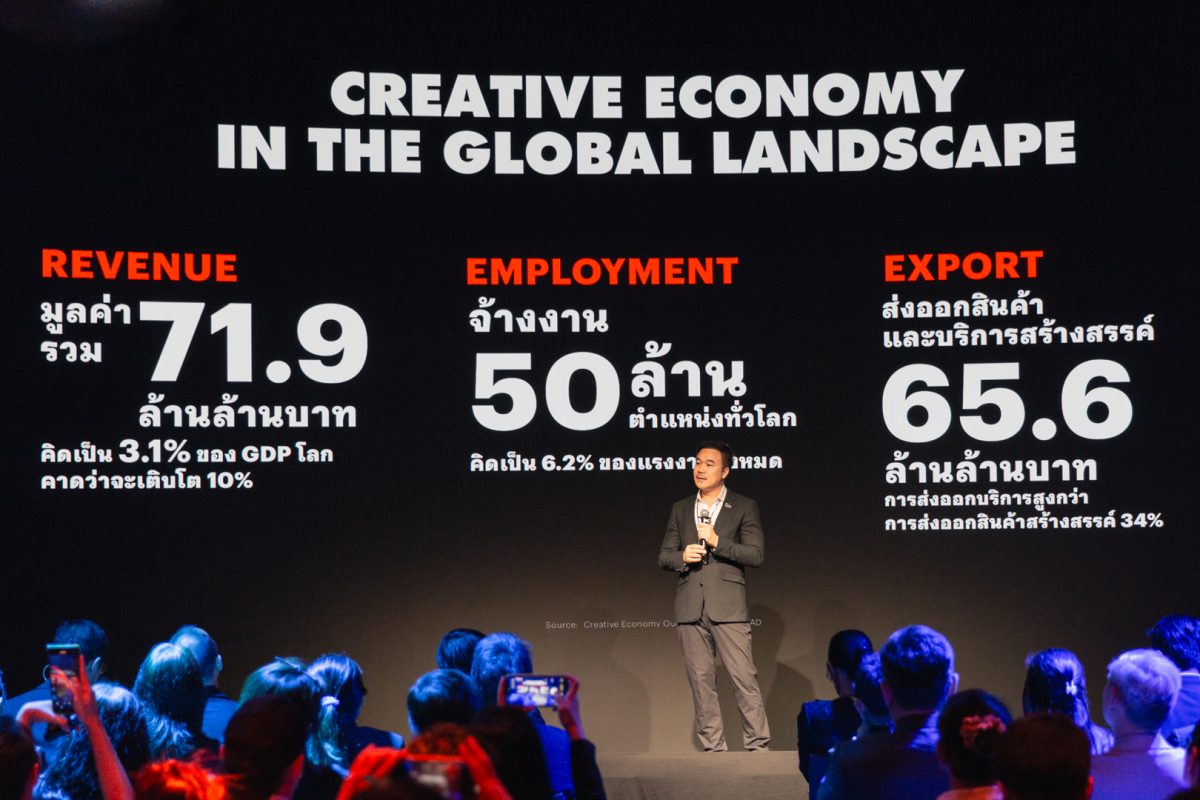
Mr. Chaiyong Ratana-Angkura, chairman of the Creative Economy Agency, delivered the opening keynote at CEA Forum 2026. Addressing the “Creative Nation & Global Outlook 2026” topic, his address reflected the growing challenges facing Thailand’s economy, which is currently projected to expand by only 1.5% to 2% amid multiple external pressures. In the picture are “Trade War 2.0” that has sent the massive influx of Chinese goods into Thai market; “geopolitics” that has escalated conflicts in various regions; and “extreme weather risks” that affect Thailand’s agricultural and tourism sectors. As a result, Thailand can no longer rely solely on traditional manufacturing and supply chain models, which depend on labor-cost and geographical-location advantages.
Mr. Chaiyong said in response to these challenges, Thailand must adjust and develop new economic engines with “creative industries” as the main tools to generate new revenue streams. The creative economy refers to the creation of economic value from creativity — built on ideas, content, and intellectual property (IP) — and delivered in the forms of digital services, creative content, and experience-based offerings such as music, movies, games, designs, and experiential tourism. These industries do not primarily compete on prices, but rather on creativity and innovation. Their products, moreover, can be distributed across borders rapidly, reducing dependence on physical supply chains and mitigating logistical and supply-chain risks.
The creative economy benefits smaller players, as it enables the distribution of wealth into local communities and secondary cities. By developing IPs, local creators can access international markets without the need for massive investment in infrastructure. Communities, therefore, are encouraged to transition from selling traditional raw materials to offering unique brand experiences with storytelling and local identity. 2026 marks a golden year for Thailand to enhance its potential, transform into a “Creative Nation”, and develop new economic engines.
CEA’s Strategy to Rev Up New Economic Engines: Developing Cities, Human Resources and New IPs to Increase Creative Entrepreneurs’ Revenue by 30%
Dr. Chakrit Pichyangkul, executive director of the Creative Economy Agency, highlighted the growing significance of Thailand’s creative industries during his Creative Economy Strategic Direction 2026 talk. Accounting for 8.01% of the national GDP, Thailand’s creative industries now contribute a Gross Value Added (GVA) of 1.44 trillion baht to the economy. These industries have also demonstrated stronger and faster recovery than the overall economy during economic crises. With an export value of approximately 391 billion baht and a workforce of 980,000 professionals in Thailand, the creative industries can no longer be considered a secondary sector; they are a primary economic engine that deserves strategic support.
According to Dr. Chakrit, Thailand’s creative economy development roadmap will success by addressing six transformative trends: “Tech & AI Acceleration” with artificial intelligence (AI) adding value to content creation; “Platform Power” that offers borderless opportunities via platforms; “Creator Economy” that is now worth about 45 billion baht; “Regional Rising” that shows provinces outpace the capital; “New Consumerism” with the emerging middle class willing to pay for premium experiences and digital lifestyles; and “High-Value IP” or the monetization of IPs.
CEA has formulated its 2026 strategies to align with the new context and focus on turning “cultural capital” into a tangible high-value “IP-based economy.” The four key strategies of the year are: 1) Developing people with AI and creativity for example through the nationwide expansion of the New TCDC, which will reach out to all regions and equip the workforce with AI-enabled creative skills; 2) Elevating Cities to the Global Stage through city branding initiatives to establish clear, unique selling points for Thai cities, etc.; 3) Transforming Culture into Monetizable Assets, which will incubate works in every stage of the entire value chain—from upstream to downstream; and 4) Expanding businesses via platforms by hosting Bangkok International Content Market (BICM) under the Thailand International Content IP Expo (TICIP), the country’s largest content trading marketplace, aimed at enabling real commercial transactions.
Dr. Chakrit said CEA will advance these strategies in pursuit of four key goals in 2026: 1) To produce an additional 300,000 creative entrepreneurs and professionals; 2) To create more than 350 new commercial-ready IPs; 3) To increase the average income of creative entrepreneurs by over 30%; and 4) To increase the Gross Value Added (GVA) of Thailand’s creative industries by 5%. The implementation of these strategies will proudly establish the creative economy as Thailand’s main economic engine.
Upgrading “New TCDC” across 20 Provinces to Support “City Branding” and “Creative Professionals”, and to Expand Access to Creative Knowledge Nationwide
Mr. Pichit Virankabutra, deputy executive director of the Creative Economy Agency, revealed highlight projects and key goals of CEA’s Creative Cities Development Plan for 2026 during Creative City & People Development session. Marking its 20th anniversary in 2025, Thailand Creative & Design Center (TCDC) is now gearing towards a new role – evolving from an inspiring space into a platform for talent development and creative skills enhancement. In support of this transformation, CEA aims to establish “New TCDC” centers in 20 provinces nationwide. CEA, moreover, will open its southern branch in “Songkhla” later this year – entrusting the new branch with supporting creative industries across Thailand’s South.
Furthermore, CEA intends to organize festivals as tools to develop cities and circular economy in target areas. These festivals will be held at both local and city levels. This year, CEA will implement the Neramyth (Creative City & Place Branding) project to propel “creative city brands” in nine provinces across all Thai regions. Its “Festival Creator 2026”, meanwhile, aims to support the development of local “festival organizers” and pave the way for festivals that suit local context to last in the long run. All these efforts are planned to ensure urban development is not concentrated in just a few major centers, but is instead distributed more evenly across the country, promoting balanced growth and enabling cities nationwide to become systematically and sustainably “livable, investable, and visitable.”
Creative Economy & Bringing Thai Content, Music, Advertising, Architecture and Design to Global Stage
Mr. Inthaphan Buakeow, deputy executive director of the Creative Economy Agency, presented plans to empower Thai creative industries – which cover content, music, advertising, architecture, design, and creative product & service sectors – during his address on Creative Industry Development. This year, CEA will continue to focus on content (movies, series and animation) as well as music. For the film, series, and animation sectors, Content Lab 2026 will be held. This program, now in its fourth consecutive year, focuses on enhancing the skills of people working in the sectors and upgrading their project capabilities. CEA is also set to host Thailand International Content IP Expo (TICIP), collaboration with the Department of Intellectual Property (DIP) and the Department of International Trade Promotion (DITP), aims to open an international marketplace for content projects and establish the largest content IP trading platform in Thailand in July 2026.
To further elevate Thai artists and the music industry onto the global stage, CEA will implement the “Music Exchange 2026.” In its third consecutive year, the program will help more than 40 Thai artists and bands perform at 40 international music festivals across 11 target markets in Asia, Europe, and the Americas under the PUSH strategy — expanding their fan base, international visibility, and commercial opportunities. Its PULL strategy focuses on bringing international music industry representatives from five key markets — China, Japan, South Korea, Indonesia, and Vietnam — to business-matching sessions with more than 75 Thai music companies and record labels. Together, these efforts aim to generate at least 24 million international impressions (“eyeballs”) for Thai artists and to double the economic value of Thailand’s music industry.
“2026 will be the year we reinforce Thailand’s image as a ‘Creative Nation.’ The country is moving away from an economy reliant on low-cost labor and mass production. It is transforming into a creative economy powered by creativity, storytelling, experiences, and intellectual property – building new engines for Thailand’s solid economic growth,” Mr. Chaiyong concluded.