
From humble beginnings in 1990 to becoming a global manufacturing juggernaut, Daikin Industries (Thailand) has spent 36 years shaping the future of climate control.
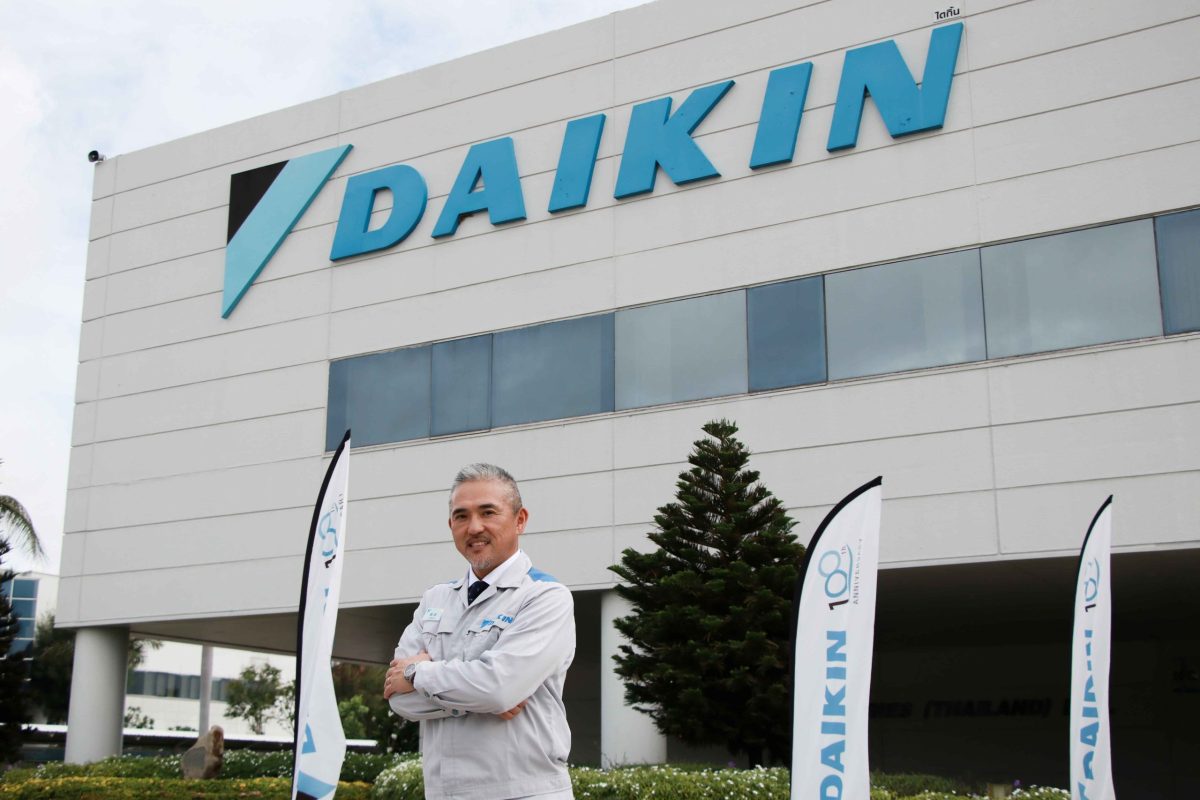
In this special Q&A, President Tsutomu Kurihara shares insights into the evolution of local production, cutting-edge green technologies, human-centred management, and how his own engineering roots drive the company’s worldwide success from its strategic home at Amata City Chon Buri.
LEADERSHIP & PEOPLE
Taking the Helm
You stepped into the President role relatively recently. What have been your top priorities in this first chapter of leadership, and what first impressions have shaped your approach at DIT?
When I assumed this role, my first priority was to listen — really listen — to what our organisation in Thailand was thinking and hoping for.
Compared with some of our other regional bases, I felt local ownership had more room to grow, and that the wonderful steadiness that has carried this organisation for 36 years now needed to be paired with a new kind of speed. For a long time, our industry enjoyed an era where what we made simply sold; competition is intensifying and markets are shifting faster than anything we’ve experienced, so we need the agility and mindset to meet situations we have never faced.
So the very first thing I did after taking office was sit down, one on one, with every manager-level colleague and above, to hear what they were thinking and wanted to build. That listening continues today, and giving local voices real ownership of where we go next remains one of my central missions as President.
People First
People are often called an organisation’s greatest asset, and Daikin places heavy emphasis on “People-Centric Management”. How does this philosophy manifest practically at your Amata City Chonburi facilities?
Based on our group philosophy, “Together, We Brighten the Future,” we firmly believe in unlocking the unlimited potential of every individual employee.
We established our dedicated Daikin Training Center in Thailand back in February 2007 because continuous learning is vital.
My personal mission as President is to cultivate an inclusive, safe environment where our workforce feels empowered to challenge new possibilities.
We invest heavily in upskilling technical talent, promoting workplace safety, and encouraging bottom-up innovations.
When our people grow professionally and personally, the company naturally succeeds alongside them.
Lessons from Toyota
You spent time seconded to Toyota Motor Corporation in 2011 before returning to lead major manufacturing divisions at Daikin. What valuable lessons did you bring back from that experience that you now apply at Daikin Thailand?
That secondment was a profound professional milestone.
Working within Toyota’s ecosystem sharpened my appreciation for lean manufacturing, waste elimination, and continuous process improvement, often known as Kaizen.
When I returned to Daikin to serve as Manager of Monozukuri and later as General Manager of the Production Department, I integrated those rigorous lean methodologies into our assembly lines.
It taught me that efficiency is not about rushing workers; it is about smoothing out the flow, empowering operators to stop the line when they spot a defect, and building quality intrinsically into every single step of production.
An Engineer’s Leadership
Mr Kurihara, you trained as an engineer at Kure National College of Technology before joining Daikin in 1990. How has your hands-on technical grounding shaped your leadership style today?
That is a wonderful question. My journey actually mirrors the timeline of Daikin here in Thailand, as I joined the company in April 1990, just months after this facility was founded.
Spending my early years immersed in the Production Department of the Air Conditioning Manufacturing Division, and later working on global shop floors, including serving as Director at Daikin Texas Technology and managing Monozukuri (a Japanese philosophy that goes beyond mere manufacturing, encompassing a spirit of craftsmanship, pride, and dedication to continuous quality and innovation), taught me that true quality originates at the gemba, the manufacturing frontline.
Engineering taught me analytical precision, but more importantly, it taught me respect for the craftsmanship of our people.
When you understand how a compressor or a heat exchanger is built from the ground up, you make better decisions that support both operational excellence and employee safety.
PLACE, TECHNOLOGY & STRUCTURE
The Amata Advantage
Being located in Amata City Chonburi Industrial Estate has been a cornerstone of your success. What specific strategic advantages does the Amata industrial ecosystem provide to a global manufacturer like Daikin?
Amata provides an exceptional, world-class operating environment.
The infrastructure, ranging from reliable power and water supply to robust waste management systems, is top-tier.
Furthermore, its strategic geographical location offers seamless logistics connectivity to deep-sea ports like Laem Chabang and major arterial highways, which is vital given that we export our modern air conditioners to numerous countries worldwide.
Beyond infrastructure, Amata fosters a thriving industrial community where we can easily collaborate with tier-1 suppliers, government bodies, and educational institutions, ensuring a steady pipeline of skilled engineering talent and robust supply chain resilience.
Green Innovation on the Line
Over more than three decades, technology has shifted dramatically. How has Daikin Thailand integrated advanced technology and environmental sustainability into its production lines, particularly regarding eco-friendly refrigerants?
Environmental stewardship is deeply embedded in our corporate DNA.
We have consistently stayed ahead of global environmental trends by adopting cleaner innovations.
For instance, we transitioned to alternative refrigerants like R410A back in 2002, and later became a pioneer in producing air conditioners utilising the environmentally advanced R32 refrigerant in 2014.
Furthermore, our in-house Research & Development Center, established in March 2005, allows us to design and test products tailored specifically to regional climates and consumer behaviours.
We combine advanced management systems, IoT-enabled automation, and strict green protocols to ensure our manufacturing processes minimise environmental impact while maximising energy efficiency.
The Regional Anchor
Operating as the central administrative base for ASEAN and Oceania carries immense responsibility. How does Daikin Industries (Thailand) support and align the various regional markets under your supervision?
Our role as the regional headquarters is to foster synergy, share best practices, and raise standards across the board.
We lead regional operations focusing on safety, quality, cost, delivery, and environmental management through what we call the “Production Daikin System”.
By standardising training and transferring cutting-edge manufacturing knowledge from our base in Chonburi to other subsidiaries in ASEAN and Oceania, we ensure that a Daikin unit manufactured or serviced anywhere in the region upholds the exact same uncompromising Japanese-engineered standards.
LEGACY & FUTURE
36 Years of Growth
Daikin Industries (Thailand) is celebrating its 36th anniversary at Amata City Chonburi. Looking back, how has the company evolved from its inception in 1990 into the colossal manufacturing hub it is today?
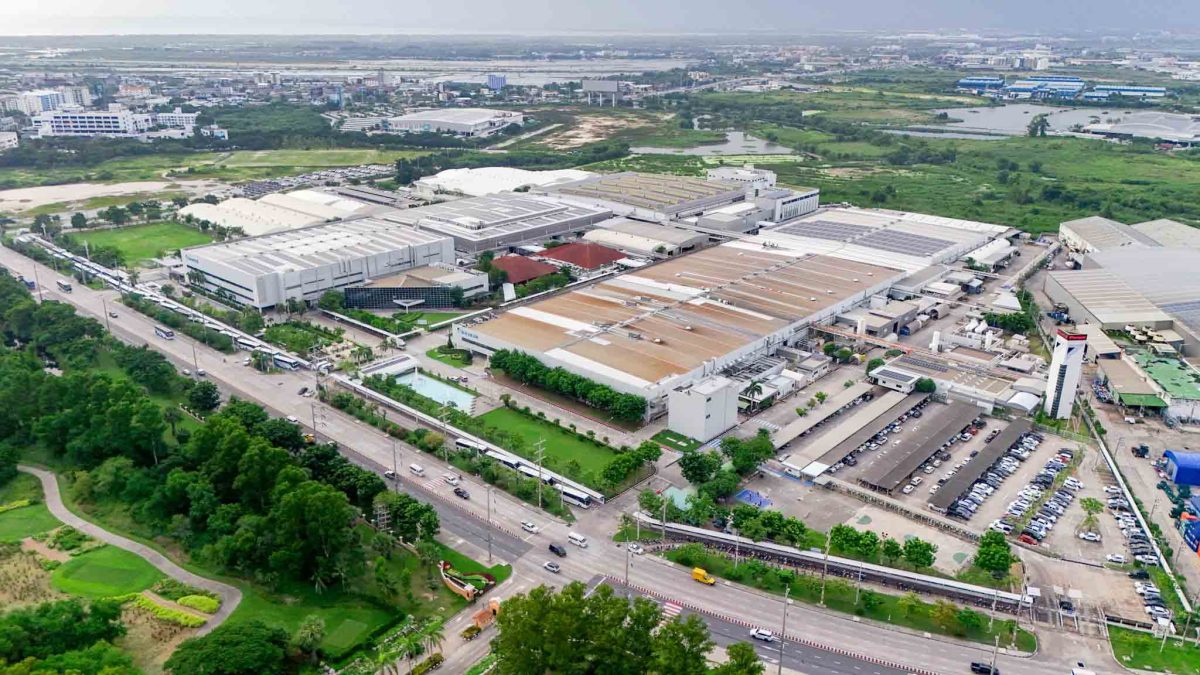
When we were established in February 1990 on a 213,000-square-metre site in Amata City Chonburi, our vision was clear: to build a world-class manufacturing base outside of Japan.
Over the past 36 years, we have grown exponentially.
We started with our first factory focusing on small room air conditioners in late 1990, followed by our second factory for commercial units in 1996, and our third facility for small VRV (Variable Refrigerant Volume) systems, or simply multi-split type air conditioner for commercial buildings, in 2009.
Today, we are not just a production plant; we are the central supervisory headquarters overseeing all administration and management operations for the entire ASEAN and Oceania regions, contributing roughly 14% to Daikin’s global production.
It has been an incredible evolution driven by unwavering dedication to quality.
Giving Back
Corporate social responsibility and community relations are increasingly vital for long-term industrial sustainability. How does Daikin Thailand give back to the local Thai community that has hosted you for 36 years?
We view ourselves as an integral member of the local Thai community, not just a corporate entity operating within it.
Our commitment extends to environmental preservation around Amata City Chonburi, tree-planting initiatives, and educational partnerships with local vocational schools and universities to transfer technical skills to the younger generation.
We also strictly adhere to safety and eco-friendly standards to protect the surrounding neighborhoods.
Giving back means ensuring that our economic growth moves in tandem with environmental health and social well-being for the people of Chonburi and Thailand.
The Next Decade
Looking forward to the next decade, what is your ultimate strategic vision for Daikin Industries (Thailand), and how will you continue to “perfect the air” on a global scale?
Looking ahead, our mission goes beyond simply manufacturing air conditioners; we aim to provide total comfort and “perfect the air” for diverse lifestyles across the globe.
We are accelerating our digital transformation, integrating automation, smart manufacturing, and AI-driven quality control into our Chonburi plants to boost productivity.
As the primary manufacturing and administrative anchor for ASEAN and Oceania, we will continue driving carbon neutrality initiatives, developing next-generation energy-saving products, and expanding our global footprint.
By marrying Japanese technological innovation with Thai craftsmanship and dedication, we are fully prepared to shape a sustainable, comfortable future for the world for decades to come.
Symbol: AMATA