
Over the course of AI Governance Week 2026 (AIGW 2026), Bangkok became one of the key venues for the exchange of knowledge on AI governance. Policymakers, international organizations, technology companies, financial institutions, educational bodies, legal experts, and specialists from many countries came together to share their perspectives. The event was convened under the leadership of the Electronic Transactions Development Agency (ETDA), which played a central role in turning global principles into tools, processes, and practices that organizations can put to real use.
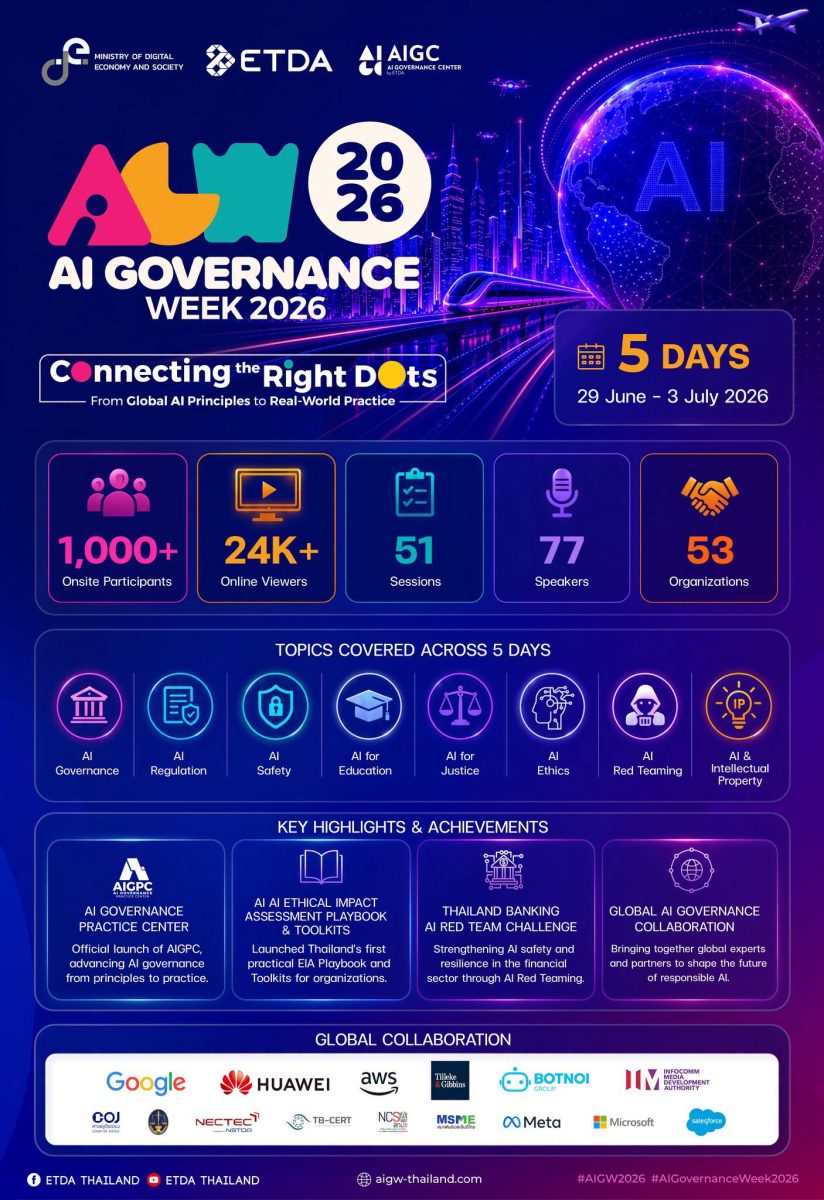
Over its five days, AIGW 2026 reflected the growing engagement and cooperation of multiple sectors in advancing AI governance in concrete terms. More than 1,000 people attended in person, while over 24,000 more joined online. The event comprised 51 sessions in total, covering topics ranging from international principles, policy oversight, and impact assessment to AI safety, system testing, and the responsible application of AI across various sectors. In all, 77 speakers and experts from 53 organizations, both Thai and international, took part.
These figures reflect not only the scale of the event but also the fact that AI governance has become a shared agenda for countries, regions, and the global community. Today’s central question is no longer simply how much AI can do, but whether AI is trustworthy enough to be applied to the economy, society, and people’s lives. As AI increasingly touches education, finance, public administration, digital trade, the justice system, and decisions that can affect people’s rights, opportunities, and safety, innovation must advance hand in hand with transparency, accountability, safety, auditability, and human-centered oversight.
Anchoring in International Principles to Build a Shared Understanding of AI Governance
One of the key lessons from AIGW 2026 is that AI governance cannot be developed by any single country alone, since AI models, data, digital services, and their effects all move across borders. Building trust therefore requires shared principles that countries around the world can agree on and use as a basis for working together.
The AIGW 2026 forum drew on frameworks from UNESCO, the OECD, and other international organizations to distill lessons across human rights, transparency, accountability, safety, risk management, and human-centered governance. On the Thai side, ETDA has taken on the role of linking these frameworks to the development of the country’s own AI governance system, while the Office of the Council of State presented the legal dimension, pointing out that AI regulation must strike a balance between protecting the public and avoiding excessive burdens on innovation.
The key takeaway from this discussion is that AI-related laws and practices should not be designed in isolation from existing systems. Instead, they need to connect with current legislation, sector-specific oversight mechanisms, and international practices that can be adapted to the level of risk a given technology poses. AI governance, then, should not be reduced to policy language alone, but should serve as a shared framework that policymakers, developers, regulators, businesses, and the public can all put into practice together.
Adapting Global Principles to the Thai Context
While the principles of AI governance are universal, their application cannot look the same in every country, since each has its own legal system, institutional structure, culture, language, level of digital readiness, and public expectations. This is why the UNESCO forum placed strong emphasis on national ownership – the idea that each country should take an active role in shaping its own approach, rather than simply importing frameworks from abroad without adapting them to local conditions.
One significant step Thailand has taken is adapting UNESCO’s Ethical Impact Assessment (EIA) to the Thai context and building on it to create the Thai AI EIA Playbook. This tool helps organizations define the purpose of their AI use, identify stakeholders, analyze ethical impacts, assess risks, and put mitigation measures in place before deployment. Rather than simply answering what ethical principles AI should follow, it helps organizations see the concrete steps they need to take, clarify who is responsible for what, and set out how to track outcomes once a system is in use.
At the policy level, discussions between Thailand’s Prime Minister and the Director-General of UNESCO on advancing the AI Governance Practice Center (AIGPC) further reflect Thailand’s intent to build domestic mechanisms that can carry international principles through to real-world application – through the development of tools, assessments, capacity building, and ongoing collaborative networks.
Building Readiness Among People, Organizations, and Institutions Alongside Legal Development
A consistent lesson across many sessions was that legislation alone cannot deliver effective AI governance. If policymakers, regulators, executives, developers, and users lack understanding or the tools to act on it, oversight will fall short. Governing AI effectively therefore has to start with developing people, organizations, and institutions that are equipped to understand risk and use AI responsibly.
On the question of human rights and access, the UNICEF session highlighted the risks AI can pose to children, women, and vulnerable groups – including issues of privacy, discrimination, inappropriate content, online harassment, and impacts on development and life opportunities. This underscored that AI governance is not only a matter of technology, but also one of rights, safety, human dignity, and fairness of access to opportunity.
At the same time, practical capacity building took shape through hands-on workshops led by technology companies including Google, Huawei, Microsoft, and Meta. These sessions focused on learning by doing – from applying AI in work and education to using tools safely, verifying system outputs, protecting data, and maintaining human oversight. Together, they made clear that AI governance only becomes real when people within organizations understand both the capabilities and the limitations of AI, along with the responsibilities that come with using it.
From AIGC to AIGPC: Turning Principles into Practice
Thailand began laying the groundwork for AI governance back in 2022, through ETDA’s establishment of the AI Governance Center (AIGC) – well before generative AI saw widespread adoption. AIGC’s role was to study emerging trends, risks, international principles, and the country’s own readiness. As the global conversation shifted from setting principles to putting them into practice, this role was elevated into the AI Governance Practice Center (AIGPC), tasked with connecting knowledge to real-world implementation.
AIGPC was never intended to be simply an academic center. It functions as a mechanism for developing playbooks, assessment tools, pilot projects, workshops, and expert networks, helping organizations apply AI governance across a system’s entire lifecycle – from design and development to testing, deployment, monitoring, and continuous improvement. The idea of “practice over policy” reflects the view that policy is only a starting point; real outcomes only follow once principles are translated into an organization’s actual working practices, whether that means impact assessment, safety testing, designing auditable systems, defining accountability, or putting in place mechanisms for appropriate human oversight of AI.
Red Teaming: From Declared Confidence to Demonstrated Trust
Another topic that drew considerable global attention was the question of proving AI safety before deployment. Trust cannot be built on a developer’s public statements or reputation alone; what society needs is evidence that AI systems have been properly assessed, tested, and had their risks brought under control.
The Red Teaming sessions at AIGW 2026 addressed both sides of this challenge: using AI to strengthen security, and protecting AI systems themselves from threats such as prompt injection, data poisoning, and attacks designed to make a model behave in ways it was not intended to. This kind of testing helps surface weaknesses that conventional testing might miss, giving organizations a clearer picture of how AI risk plays out in real-world conditions.
From the financial sector’s perspective, TB-CERT pointed out that AI is now used across identity verification, detection of unusual transactions, chatbots, and data analysis systems – which makes shared minimum security standards essential, since a failure would not be contained to a single bank but could affect confidence in the financial system as a whole. Against this backdrop, the Thailand AI Red Teaming Challenge held during AIGW 2026 was more than a technical exercise; it was an effort to build a culture of testing, verification, and proof of safety before systems go live.
Thailand as a Regional Hub for AI Governance Cooperation
AI presents a challenge that no single country can address alone. Differences in legal systems, technology, language, culture, and economic structure mean that a region does not necessarily need one uniform law, but it does need space for learning, exchange, and the development of approaches that can connect with one another.
AIGW 2026 was therefore designed not merely as a conference, but as a Regional Learning Platform bringing together ETDA, UNESCO, UNICEF, the technology sector, regulators, financial institutions, academia, and international organizations. AIGPC, for its part, will continue to support this cooperation going forward.
Thailand’s role in this context is not to set standards for other countries to follow, but to serve as a neutral space for connecting knowledge, facilitating cooperation, and helping shape regional approaches to AI governance – so that each country can adapt international principles in a way that fits its own circumstances.
AI Governance Must Be a System That Learns and Adapts
Given the pace at which AI is advancing, the laws and practices put in place today may not be enough to address tomorrow’s risks, as technology, user behavior, and use cases keep changing. Proposals from the Office of the Council of State on the legal dimension, together with lessons from UNESCO, the private sector, and security agencies, all point to the same conclusion: oversight systems need to be able to review themselves and adapt as new evidence and circumstances emerge.
Under the concept of continuous learning, findings from EIAs, workshops, tool trials, red teaming exercises, incidents, and user feedback will be fed back into ongoing improvements to policy, tools, and practices. AIGPC, under ETDA, will be responsible for gathering these lessons, connecting experts, and channeling Thailand’s knowledge back into regional and global networks. In short, AI governance should not be a document written once and left unchanged, but a learning system that can adapt, be audited, and evolve alongside technology, society, and public expectations.
From Recipient of Principles to Co-Driver of AI Governance’s Future
The path from establishing AIGC, to working with UNESCO on the EIA, to prioritizing children and vulnerable groups together with UNICEF, to building skills through workshops run by Google, Huawei, Microsoft, and Meta, to examining the legal framework with the Office of the Council of State, to elevating the center into AIGPC, and to safety testing with TB-CERT – none of these were isolated activities. Rather, they represent different facets of work carried out toward a single goal.
That goal is not simply to declare leadership in AI governance, but to build a system that turns global principles into tools, laws, human capacity, testing, and cooperation that can all be verified. In the end, leadership may not be measured by which country passes legislation the fastest, but by which country can learn the fastest, turn principles into genuine practice, and create space for other countries to grow alongside it.
What took place throughout AIGW 2026 makes clear that AI governance is no longer a distant, future concern – it is a pressing task for the present. Thailand now has the opportunity to move from being a recipient of international principles to becoming a co-driver of the future of AI governance, at both the regional and global level, through concrete action, shared learning, and the pursuit of AI that is trustworthy, safe, transparent, and accountable to society.
Follow further updates and coverage of AIGW 2026 on the ETDA Thailand page.