
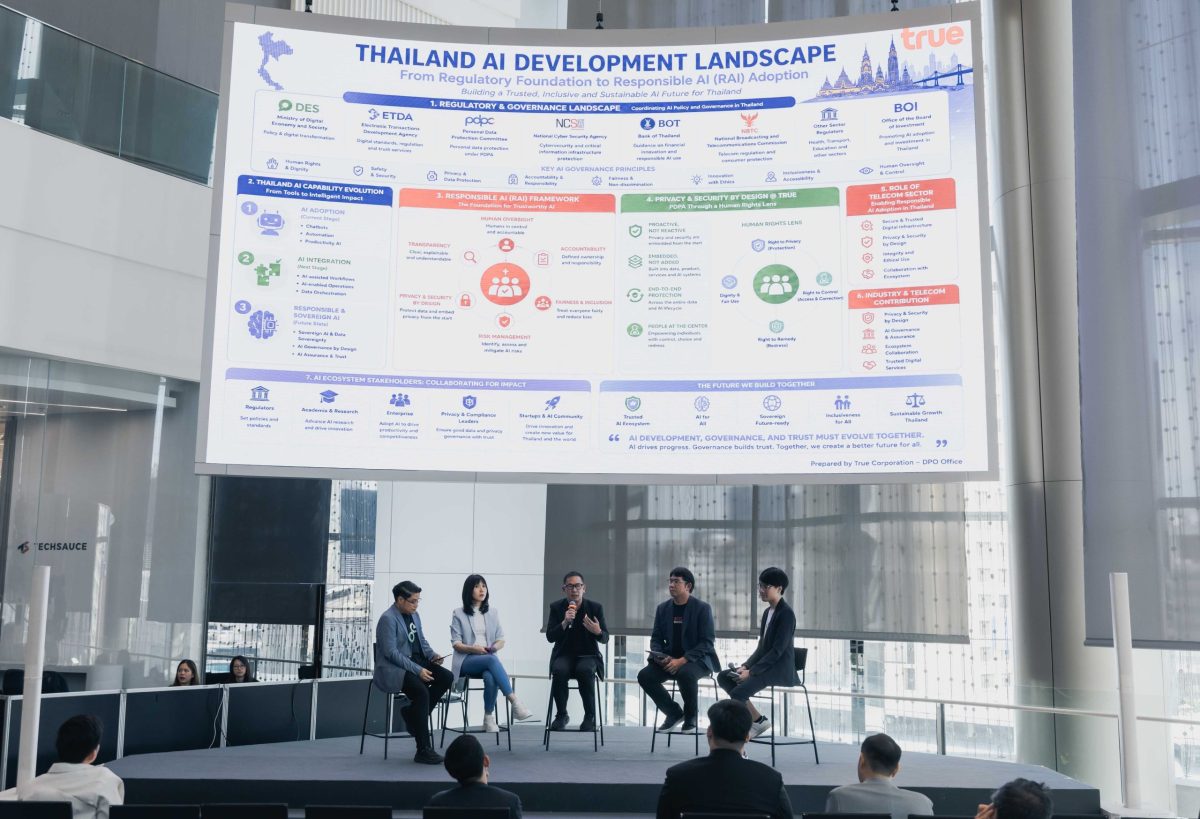
As AI becomes an increasingly essential tool in the workplace, many organizations may be asking, “How can we use AI faster and more efficiently?” But for Khun Montri Stapornkul, Head of Data Privacy Division at True Corporation Plc., the more important question is “How can we use AI responsibly, securely, transparently, and in a way that builds long-term trust?” Speaking at SCBX AI Outlook 2026: The Age of Abundant Intelligence under the theme “Beyond the Hype: Abundant Intelligences at Work,” Khun Montri shared a business perspective on the evolving role of AI, emphasizing that as AI becomes embedded in every aspect of work, the challenge is no longer only about technological capability. It is also about an organization’s readiness to govern data, empower people, and build a culture of responsible AI use from employees and enterprises to the broader digital ecosystem that connects to national-level competitiveness.

From AI User to AI Orchestrator: People Must Not Only Know How to Use AI, But Also How to Govern It
From True’s perspective, upskilling employees in the AI era is not simply about teaching people how to use new tools. It is about elevating their role from being an AI User to becoming an AI Orchestrator, someone who understands how to define the right problem, what data should be used, for what purpose, how AI can create value, and how to validate AI-generated outcomes in a way that is appropriate to the context of their work.
Khun Montri emphasized that AI should be positioned as a Decision Support tool, not a Decision Maker. While AI can help analyze data, recommend options, improve efficiency, enhance decision-making, and reduce operational limitations, the final decision must remain under human judgment, especially in matters that affect people, customers, personal data, safety, and the credibility of the organization.
This is why the concept of Human-in-the-Loop has become central to the responsible use of AI. Humans must remain part of the process from defining the problem and reviewing the output to interpreting results and making final decisions in order to prevent errors, bias, misuse of data, or outcomes that cannot be clearly explained. Ultimately, AI may help work move faster, but accountability for the outcome will always remain with humans.
Responsible AI Is Everyone’s Responsibility: Starting with Privacy by Design Before Security and Functionality
For True, the responsible use of AI is not the duty of any single department, but a shared responsibility of every employee. This is because “using AI” does not refer only to the use of chatbots or automated tools. It also includes embedding AI into work processes, applying AI to develop new services, analyzing data to create business value, driving new innovation, and connecting AI to a broader ecosystem.
The starting point, therefore, must be Privacy by Design from the outset. Before adopting AI, organizations must be able to answer key questions: What data will be used? For what purpose? Can that data be used lawfully and appropriately? How will personal data be protected? Is the system auditable? And can the organization explain how the AI works? Only after these questions are addressed should organizations move on to the dimensions of Security and Functional Requirements, ensuring that technology can operate effectively within a framework that is safe, responsible, and trustworthy.
True has therefore started by establishing an organization-level policy framework, using Data Privacy as the foundation for governing the use of data and AI. This framework is then translated into practical processes, procedures, and guidelines for each business unit, enabling every team to apply them in ways that fit their own context whether in internal operations, customer service, or the development of new businesses. This approach reflects the belief that AI is not something an organization can simply “buy and use”. Rather, it must be designed from day one to align with the principles of Responsible Business.
From Internal Standards to a National-Level AI Enabler
In the bigger picture, True views building AI readiness within the organization as the starting point for a broader national role. As a telecommunications and technology company with connectivity coverage across Thailand, True is not only an AI user, but also a key enabler of the digital economy, helping AI, cloud, digital utilities, and intelligent services reach people, businesses, and society at scale.
“As many AI tools run on True’s connectivity and digital ecosystem, the reliability of infrastructure can no longer be measured only by speed or coverage. It must also be measured by the ability to protect data, ensure security, uphold transparency, and enable the responsible use of technology. This is why True must start from within through policy, governance, employee upskilling, and a culture that helps everyone understand that AI can create real value only when it is built on a foundation of trust,” said Khun Montri.
In the era of Abundant Intelligence, the most prepared organizations may not be those with the most AI, or those that adopt AI the fastest. Rather, they are the organizations that understand how to use AI properly, safely, transparently, and under responsible human oversight. Before AI can become a driving force for the nation, it must first become a technology that people can trust. For True, that trust begins from within the organization before extending to customers, the broader ecosystem, and Thailand’s digital future.
Symbol: TRUE