
Death Fest 2026: re-member – Before Ageing, Illness, and Death returns as what is widely regarded as the most accessible death awareness fair in the world — because death is the one experience no one escapes. The event invites Thai society to explore what it means to live well and prepare for a good death together.
The festival is organised by Peaceful Death, The Cloud, and Choojai and Friends, in collaboration with a broad network of health and social sector organisations, including Thai Health Promotion Foundation, Department of Medical Services Thailand, Thai Red Cross Society, King Chulalongkorn Memorial Hospital, Faculty of Medicine Ramathibodi Hospital Mahidol University, National Health Commission Office Thailand, Department of Older Persons Thailand, the Consulate-General of Japan in Fukuoka, Cheevamitr Social Enterprise, The Active Thai PBS, and the Buddhadasa Indapanno Archives (Suan Mokkh Bangkok).
This year’s edition is presented under the theme “re-member: Before Ageing, Illness, and Death.” The concept communicates that living well and dying well are not matters for individuals alone, but something that involves everyone around us. The festival encourages people to reflect on their relationships — from family and friends to communities and society at large — and to invite those they care about to “re-member,” to come together and explore these questions collectively. By caring for one another today, difficult conversations that may feel impossible to begin can finally find their voice. When words are hard to say, Death Fest is ready to speak about the difficult things on your behalf.
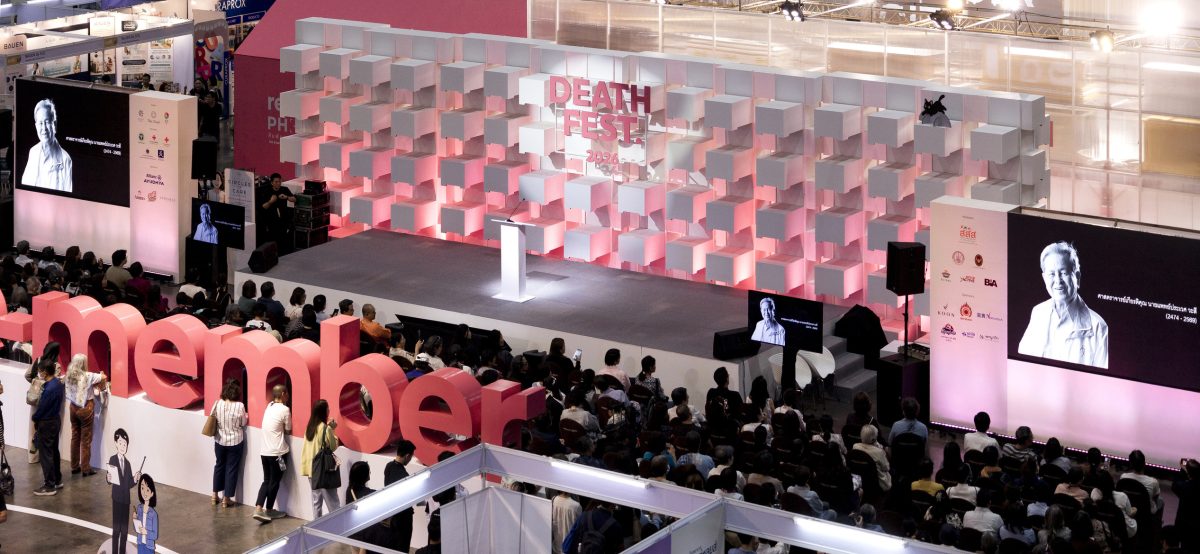
The opening ceremony of Death Fest 2026 placed “memory” at the heart of the event. The life story of Professor Prawase Wasi, one of Thailand’s most respected public intellectuals, was shared on screen through the reflections of his wife, Chantapong Wasi. Her narrative traced his lifelong work alleviating suffering from illness, his commitment to community-based care, his thoughtful preparation for the final stage of life, and ultimately his peaceful passing at home, as he had wished. The memory served as a powerful reminder of the importance of preparation and communication of one’s wishes, while highlighting the role of loved ones — family members, doctors, nurses, and close companions — whose compassion and understanding made it possible for Professor Prawase to experience a dignified and meaningful final chapter. It reinforced the message that death is never an individual matter; it is deeply shaped by the relationships that surround us, particularly those within the family — a message Death Fest seeks to emphasise this year.
Wanna Jarusomboon, Founder of Peaceful Death Group and President of Compassionate Communities Research and Development Institute Foundation, said: “Death Fest 2026 is a space for learning how to live meaningfully and prepare for the best possible farewell. We believe that living well and dying well are inseparable. Here we have gathered knowledge, skills, tools, products, and services that help people prepare for aging, illness, and death with understanding, so that they do not leave emotional burdens behind for those who remain. One of the most important elements is communicating one’s wishes for end-of-life care. When those wishes are clearly expressed, loved ones can make decisions with greater clarity and without guilt when the final moment arrives.
“Most importantly, we want everyone to have the opportunity to prepare — both practically and emotionally — and to design their own final chapter before it is too late. Death is a conversation that should begin today, while we are still well and living our everyday lives. And if you do not know where to begin, this festival will help speak the difficult words for you. We believe that a good death is not the responsibility of any one person; it belongs to families and to the network of people who surround us in a circle of care. A dignified death should be a fundamental right that everyone can access equally.”
Prasit Vitayasamrit, Co-founder of Choojai and Friends & Executive Creative Director, added:“Many people assume that an event called Death Fest must be serious or sombre. But in reality, we want to invite everyone to explore the subject in a contemporary, friendly, and approachable way. This includes immersive exhibitions such as Test Die & Funeral Design Center and Cancer City, along with activities like the BaoJai Notebook Exhibition, the Human Life-brary dialogue sessions, and storytelling corners hosted by grandparents. We want people to realise that conversations about death do not always have to feel heavy. Sometimes they can be gentle, even heartwarming — and ultimately help us appreciate the value of life even more.”
Zcongklod Bangyikhan, Editor-in-Chief & Co-Founder The Cloud, said: “Although I have never died, many people I deeply respect and love already have. I may not know what the dead feel, but I have some understanding of what the living feel. That is why Death Fest talks about departure while we are still here — and about those who remain. This is not simply a fair; it is also a storytelling platform about living well and dying well, expressed through creative forms across every square metre of the venue.
“This event is shaped by many people. We intentionally recruit elderly staff to be part of the festival team. Volunteer psychotherapists are available on site to support anyone who may feel emotionally affected by the content. We host Human Life-brary sessions where individuals share lived experiences, both within the festival and in Cancer City. And finally, visitors themselves contribute invaluable insights simply by being here.”
Highlights of Death Fest 2026
TEST DIE & FUNERAL DESIGN CENTER
A showroom where visitors can literally test coffins and explore a comprehensive funeral design centre. This year features a brand-new coffin showcase open for visitors to experience.
Cheer–Wreath–DerA curated zone featuring alternative funeral wreath designs — from aesthetically crafted arrangements to wreaths that support communities and social causes, as well as environmentally responsible options.
BaoJai Notebook Exhibition & E-Living Will
An updated exhibition introducing new editions of the BaoJai notebooks designed for different age groups, from children aged seven to seniors aged seventy, including urban residents and marginalised communities. The initiative encourages advance planning for healthcare decisions and end-of-life care.
Cancer City Live Experience
An experiential installation allows visitors to explore the emotional landscape and challenges faced by cancer patients, offering insight into the experience and preparing individuals for the possibility of confronting such realities in the future.
Human Life-brary: Die-alogue in the Dark
A platform where individuals from diverse backgrounds share personal reflections on life and death — voices and experiences that are rarely heard in mainstream society.
Human Life-brary: Unconditional Love of Our Four-Legged Friends
A conversation space exploring the bond between humans and animals — from welcoming pets into our lives to caring for them through their final moments, emphasising that love transcends appearances (No Pet Beauty Standard).
Cancer Screening Booth by Chulabhorn Hospital
Comprehensive cancer screening services using advanced technologies, including 3D breast cancer screening, HPV DNA testing for cervical cancer, and PET/CT scanning.
Samaritans of Thailand Booth
“Listening with the Heart” — a safe space for emotional wellbeing featuring four interactive areas: conversations with trained listeners, expressive writing, an emotional exploration wheel, and fundraising merchandise.
Thai Red Cross Society Booth
Information and registration for organ, eye, and body donation, raising awareness of how giving can extend life for others.
Yuen Yen Social Enterprise Booth
Providing counselling for advanced cancer patients and families seeking home-based palliative care, empowering families to support loved ones physically, emotionally, socially, and spiritually, while enabling dignified end-of-life care at home.
In addition, the festival offers extensive resources on palliative care in various forms — including support for children and companion animals — as well as forums exploring complex topics such as euthanasia and the rights of LGBTQ+ individuals at the end of life.