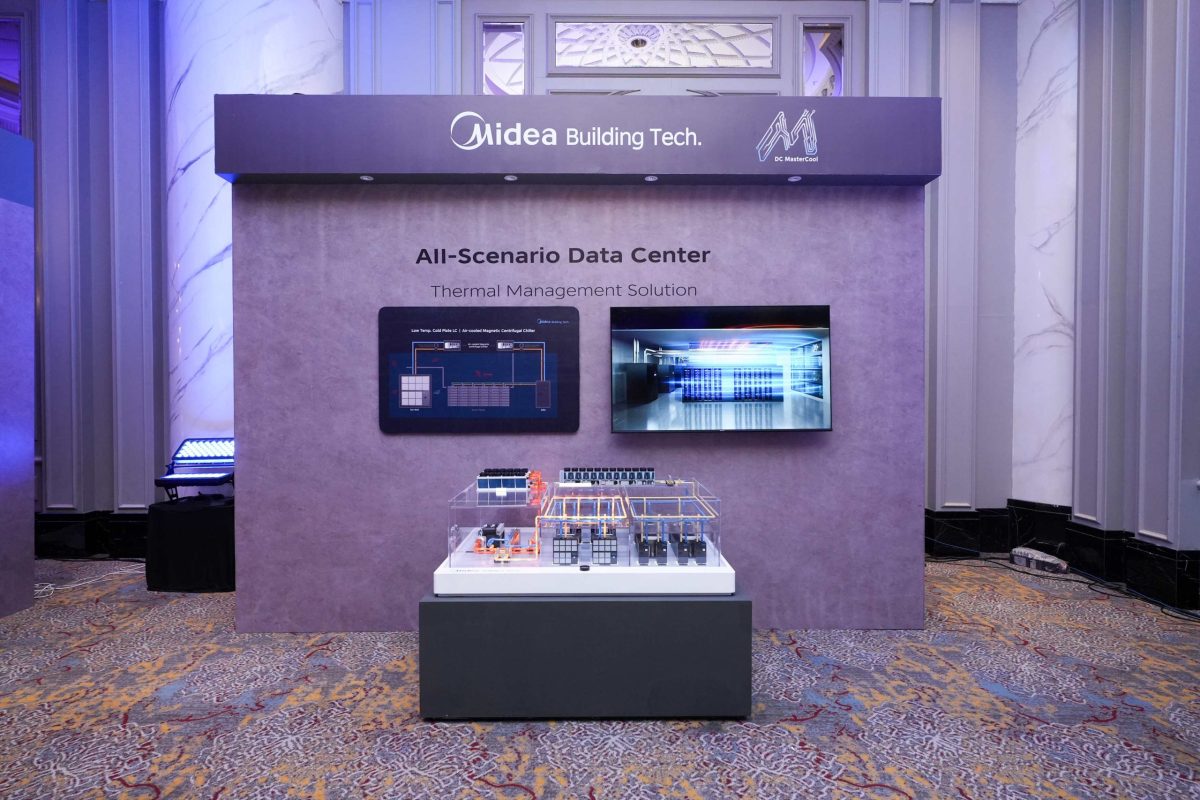
Kuala Lumper, Malaysia 28 May 2026 – Midea Building Technologies held its “Feel the Future” event, unveiling its full-stack cooling solutions for AI data centers (AIDC). The launch targets key industry pain points – slow deployment, energy efficiency concerns, and high total cost of ownership – to ensure fast, reliable and sustainable computing power for customers.
End-to-End Solutions for High‑Density Computing
With rising computing density, data centers face high costs and energy consumption. Midea’s solution covers consulting, design, delivery and maintenance, forming a closed-loop service from cooling source to terminal equipment. The company has developed a liquid‑cooling technology matrix integrating chillers, CDUs, liquid‑cooling terminals and digital operations, plus a “wind‑fluid synergy” architecture enabling flexible air‑cooling and liquid‑cooling for server racks.
Three Core Products
– Midea maglev active CDU: integrates magnetic‑bearing cooling source and distribution unit, reducing footprint by over 50%. Under tropical conditions, it achieves system PUE <1.2, while cutting delivery time and operating costs.
– Midea air‑cooled magnetic‑bearing chiller: designed for water‑scarce, high‑temperature environments, maintaining high energy efficiency with low performance degradation.
– Midea Industrial‑grade CDU: cooling capacity up to 2,600 kW, supporting high‑availability architecture for safety, stability and continuous operation.
Liquid‑Cooling Smart Manufacturing Base
In March, Midea began construction of a RMB 1 billion+ liquid‑cooling smart base in Shunde, China, to achieve independent, large‑scale production of core components such as chillers and CDUs. The base was introduced to global customers at the event and is expected to start production in August 2027.
Academic collaboration
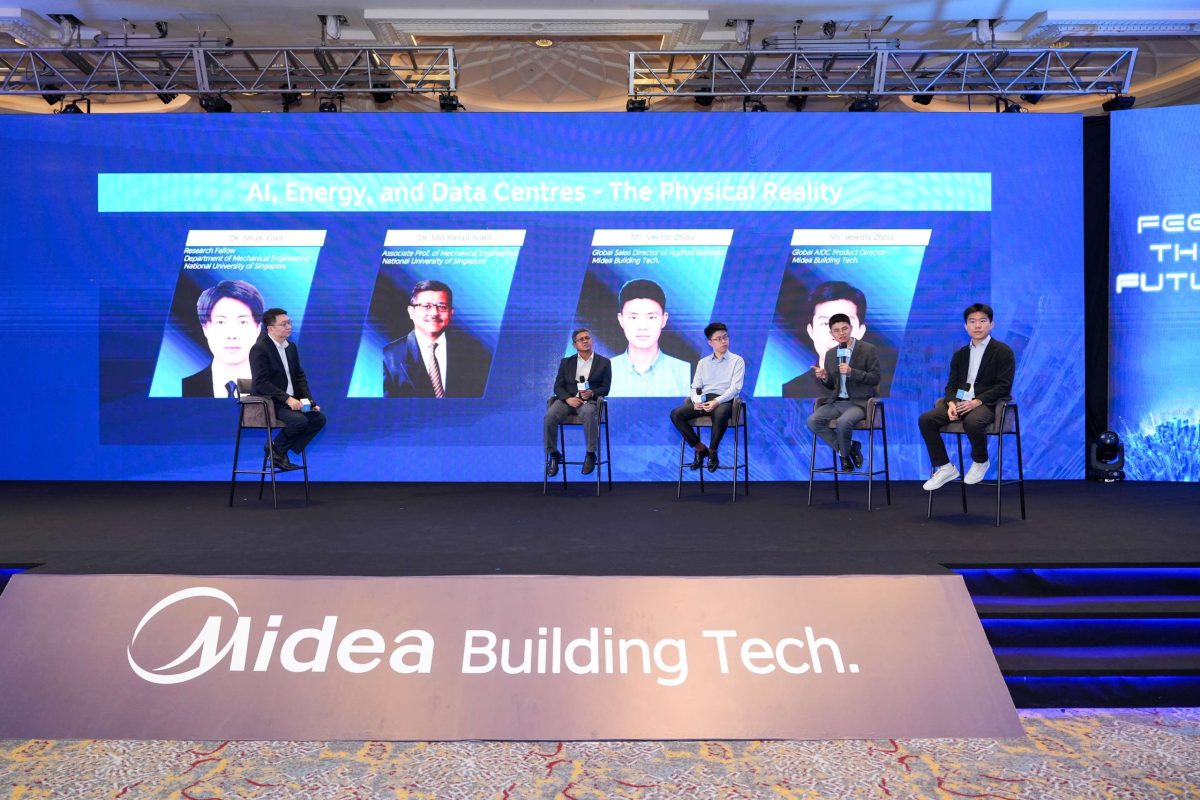
National University of Singapore experts shared insights. Dr. Md Raisul Islam presented the Sustainable Tropical Data Centre Testbed (STDCT), a 0.5 MW open laboratory in Singapore addressing energy, water and carbon challenges for tropical data centres. Midea is actively discussing cooperation on next‑phase testbeds. Dr. Guo Shuai noted that for racks above 20 kW, AM cold plates with topology‑optimized fins are key to breaking cooling bottlenecks.
In a panel discussion, experts agreed that thermal design is shifting from support to core architecture, especially in the tropics, where future metrics should go beyond PUE to focus on “compute efficiency” and total cost of ownership. Integrated real‑world testing and system engineering are seen as critical to reducing risks and accelerating adoption.
Midea Building Technologies is positioning itself as a key enabler of global AI infrastructure through full‑stack system capabilities, complete product portfolios, local manufacturing, and open innovation.