
Industrial estate giant reports 28% earnings jump and record 20bn-baht backlog buoyed by continued demand.
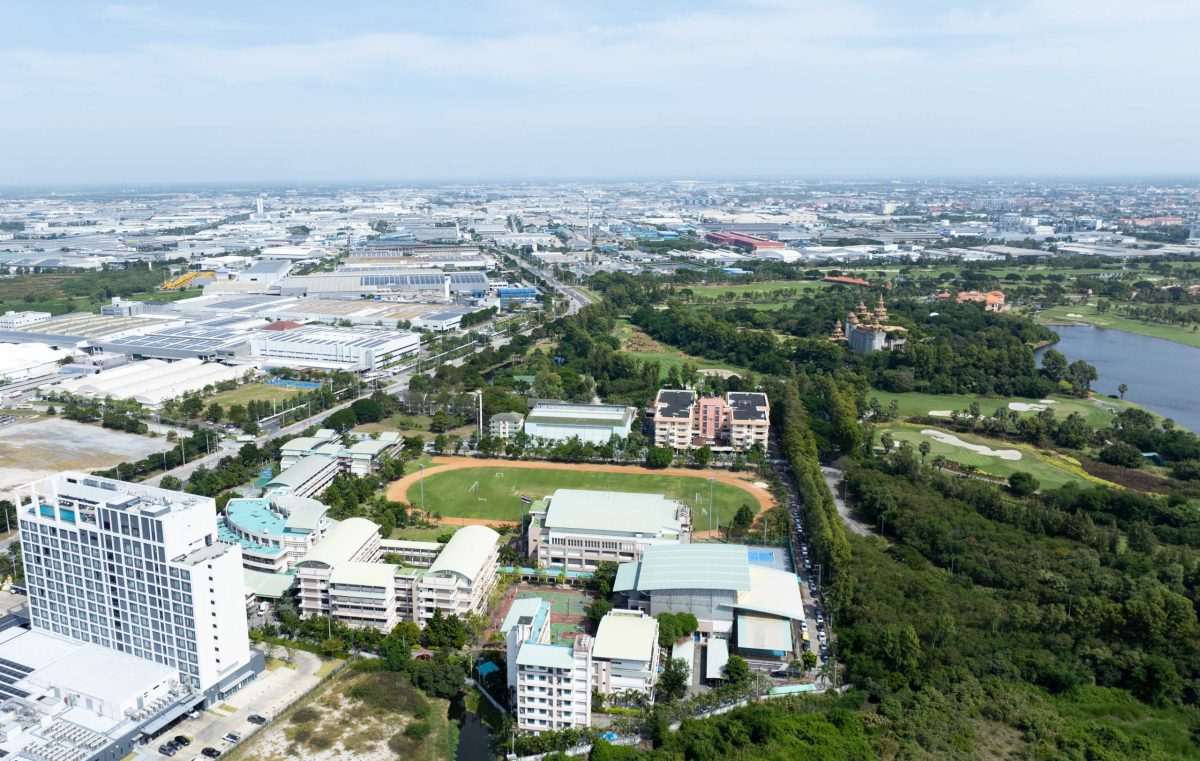
Amata Corporation PCL, Thailand’s leading industrial park developer, has reported a record-breaking financial performance for 2025, with net profit surging to an all-time high of 3,149 million baht.
The 28% year-on-year increase from 2024’s 2,467-million- baht profit comes despite a slight dip in total revenue, as the company benefited from high-margin land transfers and disciplined cost management.
According to Ms Dendao Komolmas, Amata’s Chief Financial Officer, the company’s “top-form” performance was driven by efficient cost management and a robust gross profit margin of 45%.
While total revenue for 2025 softened slightly by 3% to 14,524 million baht, the company’s core business segments remained resilient:
- Real Estate Sales: Contributed 8,703 million baht (60% of core revenue), down by 3%, due to delayed land transfers, with 1,645 rai of land transferred (1,493 rai in Thailand and 152 rai in Vietnam).
- Utility Services: Generated 4,545 million baht (31% of core revenue), down by 5% due to the decline in service fees in Vietnam.
- Rental Income: Rose by 10% to 1,034 million baht, following an expansion in ready-built factory space.
As of 31 December 2025, Amata’s total assets stood at 69,654 million baht, up 7% from the previous year.
Dividend and Future Outlook
In light of the record earnings, the Board of Directors on 2 March 2026 approved a total dividend payment of 1.10 baht per share for the 2025 operating year.
A final dividend of 0.75 baht per share will be paid out of non-BOI promoted activities.
The company is entering 2026 with a formidable reserve of pending revenue.
Amata currently boasts a record backlog of 21,131 million baht, providing a significant revenue cushion for the coming year.
Investment Climate
Mr Yasuo Tsutsui, CEO of Amata’s Thailand Real Estate Business, noted that while the global economy remains “fragile” due to geopolitical tensions and trade policy uncertainty, Thailand has become a primary beneficiary of supply chain shifts, particularly in industries such as digital infrastructure and AI, advanced manufacturing, electric vehicles, etc.
“The Thai economy showed improved momentum in 2025, expanding by 2.4%,” Mr Tsutsui said.
“This was bolstered by electronics exports, a recovering tourism sector, and strong private investment.”
The investment landscape in Thailand reached a historic milestone in 2025.
Data from the Board of Investment (BOI) revealed that applications for investment promotion hit an all-time high of around 1.88 billion baht—a 67% increase over the previous year.
The digital sector attracted the highest investment, followed by electronics, renewable energy, automotive, agriculture, and food processing. Notably, 59% of investments were in the Eastern Economic Corridor (EEC), where Amata’s main estates are located.
Thailand’s overall Foreign Direct Investment (FDI) in 2025, amounted to 1.36 billion baht, an increase of 66% from the previous year. Singapore was the leading investor by value, followed by Hong Kong, China, Japan, and the United Kingdom.
The International Monetary Fund (IMF) anticipates that growth continues to remain, forecasting a rate of 3.3% in 2026 and 3.2% in 2027, mirroring the expected 3.3% expansion in 2025.
Strategic ‘All Win’ Philosophy
Under the company’s ‘All Win’ philosophy, its integrated industrial cities are designed to create long‑term ‘All Win’ value — for business performance, for society, and for the environment. Amata remains dedicated to expanding these industrial city ecosystems throughout the region, leveraging prime strategic locations, state-of-the-art utility platforms, comprehensive services, and long-term management to attract high tech FDI and foster sustainable growth.
Symbol: AMATA