
- The assessment highlights the Thai financial sector’s positive evolution in line with international sustainability standards
- Seminar calls for the financial sector to urgently integrate industrial pollution and air quality risks into credit screening criteria
Fair Finance Thailand (FFT) announced the results of its 8th annual policy assessment of Thai banks, revealing that the Thai financial sector is successfully evolving alongside international ESG standards. Despite the adoption of the more rigorous Fair Finance Guide International (FFGI) 2025 framework, average scores across the sector have continued to rise.
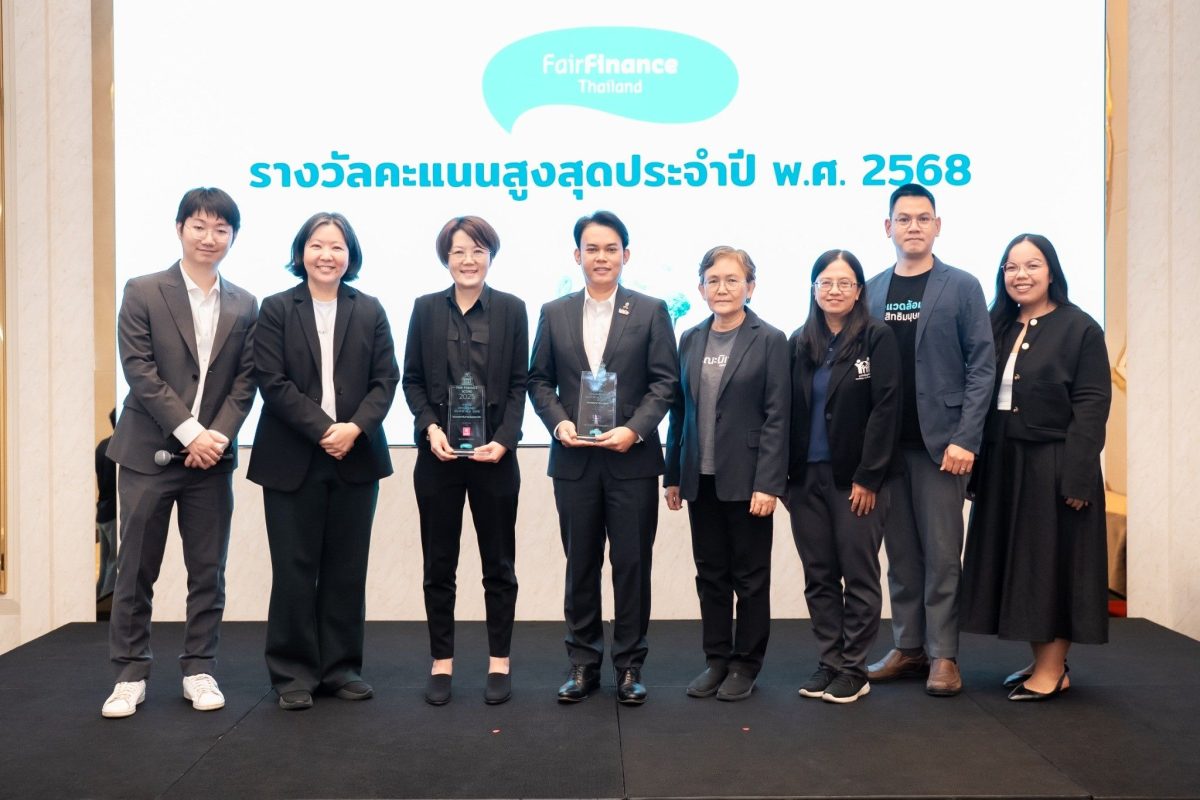
Concurrently, a seminar urged banks to move beyond general policy and begin integrating industrial pollution and PM2.5 risks into their core credit assessments to prepare for upcoming environmental legislation.
2025 Assessment: Proving Adaptation Against Global Benchmarks
For the 2025 assessment, the coalition adopted the newly updated FFGI 2025 criteria, which introduced more stringent standards. Despite this higher bar, the Thai banking sector demonstrated continued commitment and resilience; the overall average score of the 11 assessed banks rose from 28.36% in 2024 to 28.84% in 2025, with 8 out of 11 banks achieving higher scores.
- Commercial Bank Category: TMBThanachart Bank (ttb) secured the top spot for the 7th consecutive year with 40.75%, followed by Siam Commercial Bank (SCB) at 38.95% and Kasikornbank (KBANK) at 38.47%
- Specialized Financial Institutions (SFIs): The Government Savings Bank (GSB) maintained its lead with a score of 27.90%
Itchaya Sengmee and Settanan Khansorn, representatives of the Fair Finance Thailand research team presented the findings, noting that the competitive gap between leading banks is narrowing as more institutions adopt international ESG best practices.
Read the full policy assessment report here: https://fairfinancethailand.org/bank-guide/bank-assessment/?isPositive=True
Seminar Highlights: The Clean Air Act and PRTR—The Role of Thai Banks
While the annual assessment tracks policy disclosure, the parallel seminar, “Responsible Finance and Pollution: Clean Air Act–PRTR and Thai Bank Policies,” highlighted the urgent need for banks to address industrial air pollution. Experts emphasized that banks must strengthen due diligence in lending and investment decisions by systematically assessing air pollution risks, given the forthcoming Draft Clean Air Act and the Pollutant Release and Transfer Register (PRTR) Act.
Penchom Saetang, Executive Director, Ecological Alert and Recovery–Thailand (EARTH), highlighted how the PRTR Act provides the essential missing link for bank transparency: “The PRTR Act is a critical tool for financial transparency. Once implemented, it will provide a central, public database of toxic emissions that allows banks and insurance companies to assess the real environmental behavior of their clients. This data transforms environmental due diligence from a guessing game into a fact-based risk assessment.”
Asst. Prof. Kanongnij Sribuaiam, Faculty of Law, Chulalongkorn University; Co-founder, Thailand Clean Air Network (ThaiCAN), explained the roles of both Acts, which aim to establish a new ecosystem where banks must share liability if they provide financial support to polluters. She further added that: “As the primary regulator, the Bank of Thailand must first establish this system and subsequently issue it as a mandatory regulation for all banks to follow”
Kanjana Suaysom, Director, Industrial Pollution Section, Pollution Control Department (PCD), noted that new laws will empower both regulators and banks to close enforcement gaps: “Existing environmental laws are often siloed, leaving enforcement gaps. The Clean Air Act and PRTR Act will help bridge these gaps, but the financial sector must also step in as a partner through ‘stick and carrot’ mechanisms—whether by setting stricter lending conditions for polluters or offering interest rate reductions to support green investments—to create an ecosystem that fosters sustainable industry.”