Thailand RISE Fund Rebrands Thai Research Funding to Drive an Innovation Economy

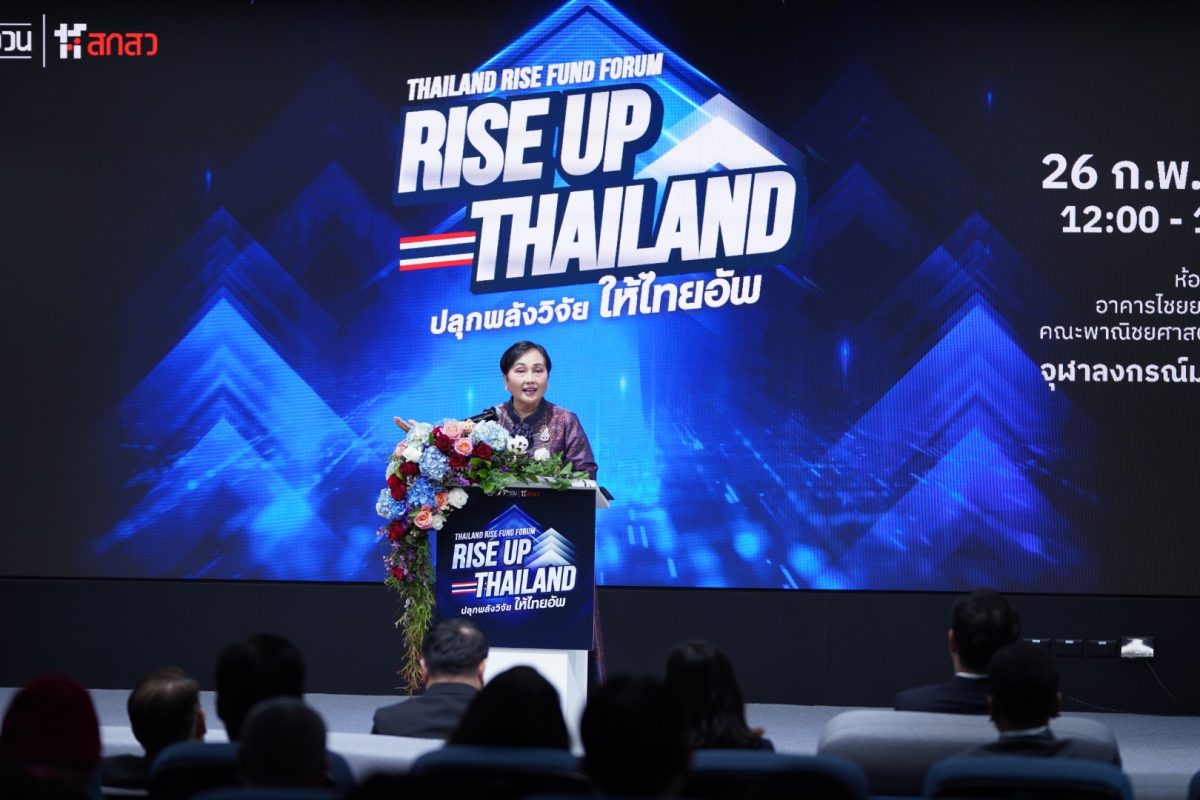
The Science, Research, and Innovation Promotion Fund (SRI Fund), under Thailand Science Research and Innovation (TSRI), in collaboration with Chulalongkorn University, organized the national forum Thailand RISE Fund Forum: RISE UP THAILAND for the third time. The event aims to unlock research potential and translate academic work into tangible economic and social value. Following outreach events in Thailand’s northeastern and northern regions, this forum was held at Chulalongkorn University as a platform for stakeholders in the central and eastern regions.
Amid the steady growth in Thailand’s research output, the key question is no longer how much research the country produces, but whether that research generates economic and social impact.
Professor Dr. Wilert Puriwat, President of Chulalongkorn University, stated that national progress depends not only on the accumulation of knowledge but on the ability to transform knowledge into a systemic driving force. This involves integrating policy, research, innovation, and industry into a coordinated framework. Chulalongkorn University aims to serve as a strategic partner in national development by fostering knowledge creation, developing high-quality human capital, and linking research with policy and systemic challenges. The university aims to extend academic work beyond laboratories into practical applications that yield measurable benefits for the economy, society, and quality of life, while enhancing Thailand’s long-term competitiveness and sustainability.
Professor Dr. Sompong Klaynongsruang, President of TSRI, emphasized that Thailand’s science, research, and innovation system must be driven systematically with clear direction—from policy strategy and targeted research funding to the practical utilization of research outcomes in economic and social sectors. Collaboration among universities, the private sector, and government agencies is essential. When all sectors move in the same direction, research will not only generate knowledge but also produce tangible national development.
Asst. Professor Dr. Ake Pattaratanakun, Chairman of Thailand RISE Fund Strategic Communications Subcommittee, noted that although Thailand’s research output has increased by more than 2.8 times over the past decade, and many studies have been published in international journals, the country’s main challenge is no longer increasing research quantity but enhancing its economic and social value.
The rebranding of the Science, Research, and Innovation Promotion Fund into the Thailand RISE Fund represents more than an image change. It marks a strategic shift from being primarily a funding source for academic research to becoming a central driver of Thailand’s research and innovation ecosystem.
One of the structural challenges in Thailand’s research system is the gap between researchers and the business sector, with limited systematic mechanisms for collaboration. The Thailand RISE Fund is designed to serve as a systemic intermediary, linking research to real economic needs. The focus is on measurable outcomes—proof of impact—rather than the number of academic publications. The goal is to foster new businesses, technologies, and industries built on Thai knowledge.
The RISE framework encompasses four dimensions: Research, Innovation, Science Excellence, and Ecosystem. The Ecosystem dimension particularly emphasizes collaboration among universities, businesses, government agencies, and communities to build a comprehensive innovation-driven economy.
A key strategy of the Thailand RISE Fund is nationwide engagement, enabling researchers and entrepreneurs in regional areas to access information and develop collaborative projects aligned with local economic contexts. This reflects a shift from a centralized system toward a more distributed innovation ecosystem.
Ultimately, the Thailand RISE Fund aims to transform Thai research from “research for journals” into “research for the nation,” thereby increasing economic impact and enhancing the quality of life, while laying the groundwork for sustainable, long-term development.