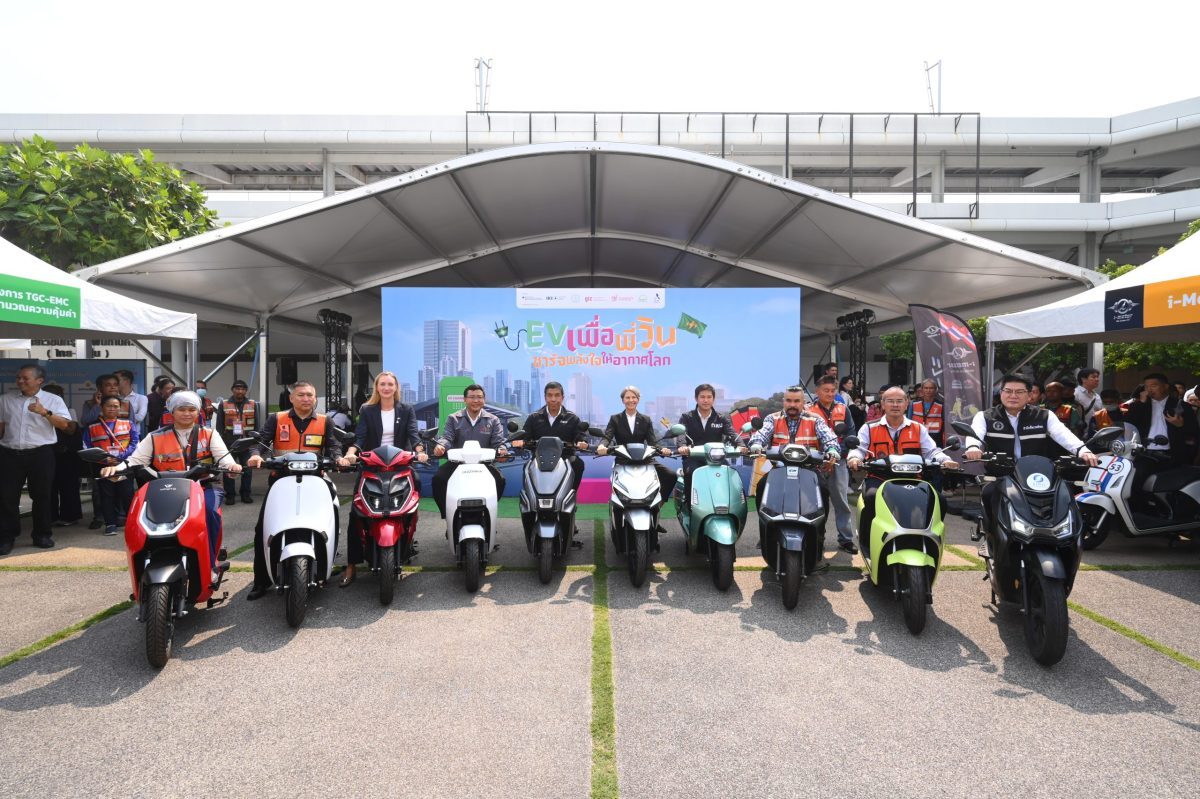
The Bangkok Metropolitan Administration (BMA), in partnership with GIZ via the Thai–German Cooperation on Energy, Mobility and Climate (TGC EMC) project, has officially launched the “EV for Motorcycle Taxi Riders” project. The initiative is built on a Win–Win–Win concept: benefits for the city, lower costs for riders, and measurable environmental improvement. A study from the TGC EMC shows that electric motorcycles can reduce riders’ operating costs up to 7X, lowering expenses to around THB 7,200 per year and cut PM2.5 emissions by approximately 16 tons annually.

The “EV for Motorcycle Taxi Riders” project by BMA and GIZ in cooperation with King Mongkut’s University of Technology Thonburi, and the Electric Vehicle Association of Thailand (EVAT) under TGC EMC, addresses structural barriers to support the motorcycle taxi transition towards electric motorcycles through a pilot daily rental model priced at THB 75–140 per day, along with charging and battery-swapping systems that eliminate waiting time. More than 200 motorcycle taxi riders and BMA street sweepers in Bangkok’s Dindaeng and Phayathai districts will join the initial test phase, receiving information on costs, maintenance, and support systems needed for real-world operations. From this group, 30 participants will be selected for a one-month, without-cost pilot to collect in-depth data for future city-wide expansion.
A study conducted under TGC EMC found that more than 89,000 motorcycle taxi riders operate across over 5,300 locations in Bangkok. These riders serve as the “capillary transport system” that supports the city’s main transport network. However, reliance on fuel-powered motorcycles contributes to living costs and air pollution, generating an estimated 80,000–100,000 tons of CO₂ per year and around 16 tons of PM2.5 annually. This is equivalent to burning approximately 3,800 rai of farmland or the annual dust emissions from 250–300 Bangkok red-cream buses operating throughout the year.
Chadchart Sittipunt, Governor of Bangkok stated that tackling PM2.5 in Bangkok requires practical solutions that can scale into policy. The “EV for Motorcycle Taxi Riders” project is designed as a pilot to test the transition to electric vehicles in real operational conditions, starting with motorcycle taxis, which are essential to mobility in a city with many small streets and alleys. He added that PM2.5 also comes from other sources such as buses and trucks, which must be addressed systematically. The project aims to generate insights that can inform broader measures for other transport modes and support Bangkok’s transition toward a low-carbon city.
Under the project framework, BMA will define the overall direction. The Environment Department will manage PM2.5 data and health impact analysis, while the Traffic and Transport Department will coordinate with motorcycle taxi stations and oversee EV operations in real settings. The pilot results will serve as a data foundation for policy recommendations and future city-level expansion.
Dr. Dominika Kalinowska, Director of Transport Projects, GIZ Thailand, said that fuel-powered motorcycle taxi riders spend around THB 19,000-49,000 per year on fuel. In comparison, electric motorcycles can cut annual costs by up to 7X, reducing expenses to approximately THB 7,200, increasing net income and reducing financial burden while cutting PM2.5 emissions by around 16 tons per year. Despite growing interest in EVs, many riders remain concerned about upfront vehicle costs, infrastructure readiness, battery systems, and real-world suitability.
To address these concerns, the “EV for Motorcycle Taxi Riders” project collaborates with electric motorcycle manufacturers and distributors to develop solutions that directly respond to these challenges. This includes battery systems, maintenance services, and battery-swapping stations that allow continuous operation without charging delays. The pilot focuses on Din Daeng and Phaya Thai areas, alongside a daily rental model starting at THB 75 and financial access solutions in partnership with institutions such as the Government Savings Bank, including green loans and hire-purchase schemes. These measures aim to lower adoption barriers and support long-term transition to electric motorcycles.
Samart Doraburan, the leader of the Bang Kruai motorcycle taxi group and a pilot participant of the project, shared that many riders were not opposed to EVs but were hesitant due to high upfront costs and concerns about charging time and daily range. For riders, stopping work means losing income. After testing the EVs, he found that operating costs were clearly lower and charging or battery swapping was easier than expected. Riders could continue working without interruption, making EVs a practical option that reduces daily operating expenses.
The “EV for Motorcycle Taxi Riders” project marks a shift from discussing PM2.5 problems to implementing solutions on real streets. By using real operational data from motorcycle taxi riders, the project aims to prove that a Win–Win–Win model—lower costs for drivers, cleaner air for residents, and sustainable urban development—is achievable. The pilot is scheduled to begin in March 2026, with plans to scale toward policy-level expansion in Bangkok and advance the city’s long-term low-carbon strategy.
Insa Illgen, TGC EMC Programme Director, GIZ Thailand, said “To the motorcycle taxi riders here today: your participation is the most important factor in the success of this project. Your experience, your feedback, and your trust will shape the future direction of this initiative. This is not a top-down transformation — it is a collaborative process. Today also marks the beginning of long-term cooperation for our partners from government, industry, and finance. The journey toward sustainable mobility requires continued coordination, innovation, and commitment. TGC EMC is ready to provide our strong support for Bangkok’s efforts to reduce emissions, improve air quality, and enhance quality of life through sustainable transport solutions.”