
Bangchak Group, through Bangchak Corporation Public Company Limited, is proactively laying a long-term foundation for sustainable bioenergy feedstock to support the production of Sustainable Aviation Fuel (SAF). Building on its leadership as Thailand’s first producer of 100% Neat SAF, the Group is expanding toward a full value-chain ecosystem through the signing of a Memorandum of Understanding (MoU) with Rajamangala University of Technology Isan (RMUTI). The project builds on the Fry to Fly initiative by extending SAF feedstock development from waste-based sources to agricultural feedstock under the Farm to Fly approach, supporting long-term sustainable SAF production.
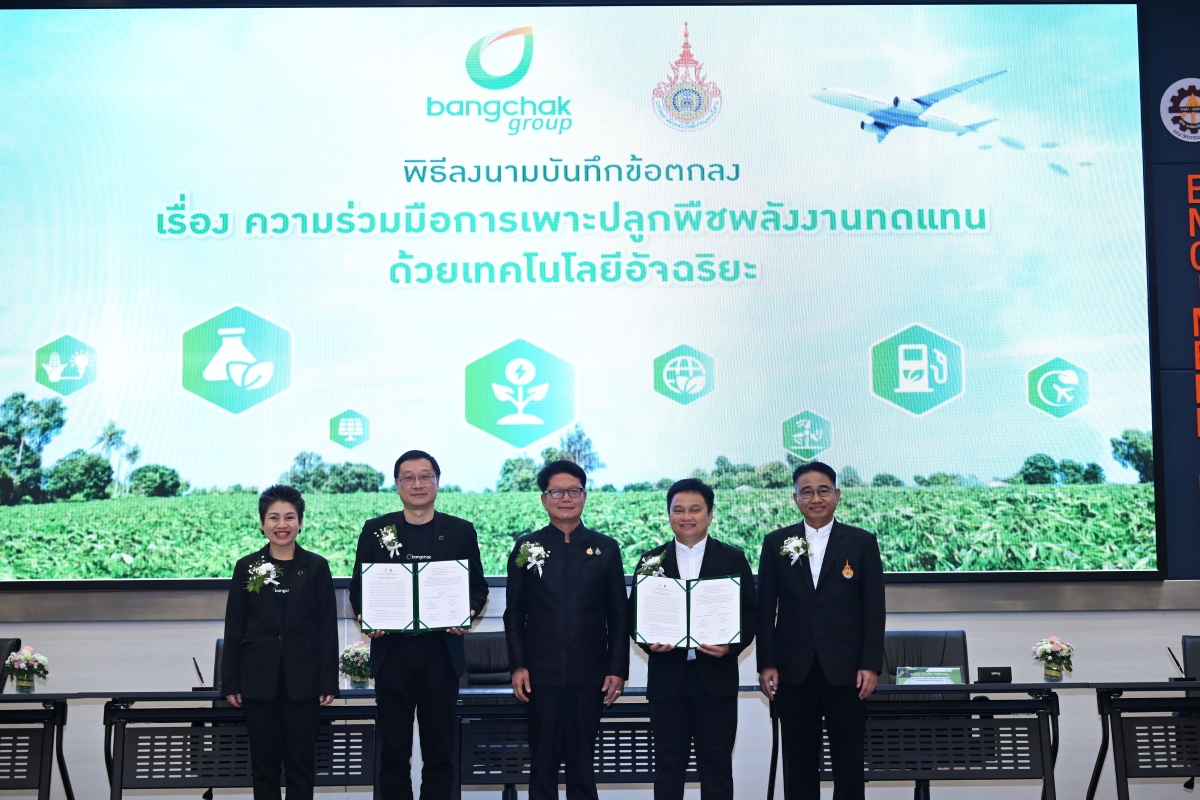
The collaboration focuses on research and development of Pongamia (Pongamia pinnata), a high-potential energy crop, utilizing smart and precision technologies to support future commercial-scale SAF production. The MoU signing ceremony was held at RMUTI, Khon Kaen Campus.
The ceremony was presided over by Mr. Karam Khamphithun, Permanent Secretary of Khon Kaen Province. The MoU was jointly signed by Mr. Bundit Hansapiboon, Acting President, Refinery and Marketing Business Group, Bangchak Corporation Plc., and Associate Professor Dr. Bandit Kritakhom, Vice President for Research, Innovation Development, and Academic Services, RMUTI. Senior executives from both organizations, along with representatives from government agencies, private sector, and public organizations, attended as witnesses.
Mr. Karam Khamphithun, Permanent Secretary of Khon Kaen Province, said that Khon Kaen places strong emphasis on integrated collaboration among the public sector, private sector, and academic institutions to drive sustainable renewable energy development. He noted that the smart energy crop cultivation research project is well aligned with both provincial and national policies, and that the application of smart farming and IoT technologies will enhance cultivation efficiency suited to the northeastern region. The project is expected to be scalable to farmers and local communities, helping generate income, reduce dependence on imported energy, and serve as a model for community-based economic development alongside long-term environmental sustainability.
Mr. Bundit Hansapiboon, Acting President, Refinery and Marketing Business Group, Bangchak Corporation Plc., stated that Bangchak places strong emphasis on advancing clean energy alongside the development of a sustainable bioenergy feedstock base. The collaboration with RMUTI builds on the ongoing partnership between the two organizations in the development of SAF, grounded in research and the utilization of domestically sourced bio-based feedstocks. This initiative aims to support future SAF production while reducing reliance on a single feedstock source, such as used cooking oil. The approach is consistent with developments in countries such as India and Australia, where Pongamia has been developed in concrete terms as a bioenergy feedstock and fuel of the future.
Associate Professor Dr. Bandit Kritakhom noted that RMUTI is committed to research and innovation with practical industrial applications. The Pongamia cultivation research project will enhance knowledge in energy crops, improve land-use efficiency, and create opportunities to develop bioenergy feedstocks that do not compete with food crops—thereby accelerating sustainable national development.
Pongamia (Pongamia pinnata) is a medium- to large-sized perennial tree, typically reaching 15–25 meters in height. It begins yielding seeds approximately four years after planting, with full productivity generally achieved between years seven and eight. Pongamia seeds contain an average oil content of 20–40% by weight. Various studies estimate that, under proper plantation management, Pongamia can yield around 1,300 kilograms of seeds per rai per year, equivalent to approximately 380 liters of oil per rai annually.
Pongamia is a non-food crop and can be cultivated on marginal land unsuitable for major economic crops, such as arid or saline areas, reducing competition with food security. It also holds strong potential as a bioenergy feedstock aligned with ISCC (International Sustainability and Carbon Certification) standards, which ensure traceability, responsible land use, and greenhouse gas emissions reduction across the value chain—meeting sustainability requirements accepted by global markets.
In addition, the reduction of greenhouse gas emissions throughout the value chain provides a potential pathway for the future development of carbon credits, in line with relevant standards and regulatory frameworks.
Following the ceremony, participants took part in a Pongamia planting activity and visited the experimental cultivation plots in Khon Kaen Province. The visit enabled exchanges of knowledge on plantation management, smart technology applications, and approaches to improving productivity of renewable energy feedstocks at the local level.
This collaboration reflects Bangchak Group’s leadership in advancing future fuels through concrete action, expanding sustainable bioenergy feedstock supply, strengthening energy security, and supporting environmental stewardship alongside long-term economic and social development, contributing to Thailand’s journey toward Net Zero emissions by 2050.
Symbol: BCP