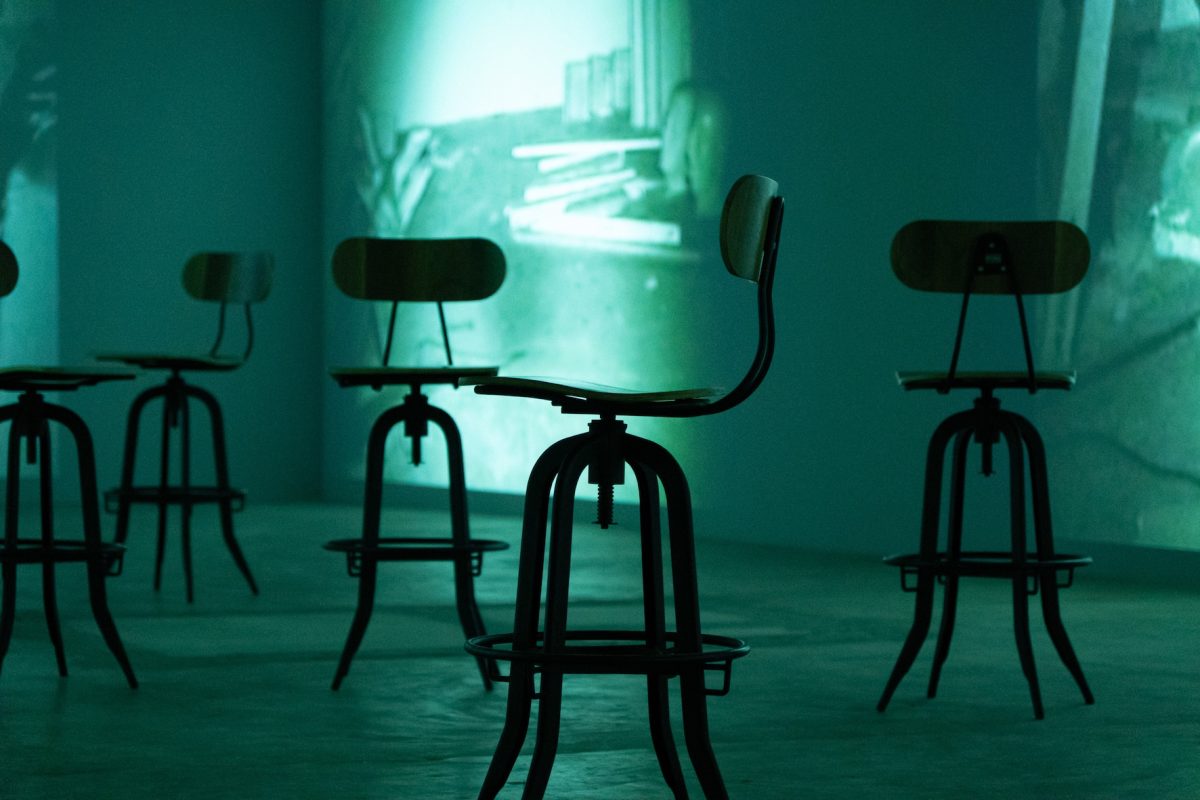
Imagine an artist’s studio at night. After the artist has left the room, only desks, chairs, work tools, and scattered objects remain. Yet through the lens of an infrared camera, movement emerges: a mouse crosses the floor; a moth passes close to a camera; a cat prowls through the darkness; and an unidentified sound interrupts the silence.
These nocturnal sights and sounds inspired Mapping the Studio I (Fat Chance John Cage) (2001), the celebrated video and sound installation by seminal American contemporary artist Bruce Nauman. This legendary work will be on view at Bangkok Kunsthalle from 14 November 2026 to 4 April 2027.
Born in 1941, Bruce Nauman is one of the most influential artists in the postwar period. For more than six decades, he has created various forms of art – encompassing sculpture, performance, video, sound, installations, and drawing.
His practice has long questioned the boundaries of art and the meaning of artists, exploring the relationship between body and space, language and meaning, action and repetition, control and failure, and presence and absence.
To Nauman, the studio is not simply where artworks are produced, but a territory of uncertainty in which the artist does not need to know in advance what an artwork will become. Within it, failure, repetition, boredom, waiting, and chance can acquire meaning. The studio allows art to exist before it has been fully recognized as art.
At the beginning of his career, Nauman worked alone in a former grocery store that he had rented as a studio in San Francisco. With few materials and uncertainty about what an artist was actually supposed to produce, he began asking a deceptively simple question: what does an artist do when alone in the studio?
His answer became foundational to his entire practice:
“If I was an artist and I was in the studio, then whatever I was doing in the studio must be art.”
Art is not just about output but also process. Walking, standing, bouncing balls, moving his body, repeating a gesture, playing the violin or simply pacing around the room therefore could become artistic material.
The studio becomes Nauman’s frontier. The heroic westward movement of the American mythology of conquest is replaced by walking back and forth across a floor. The unknown is no longer somewhere beyond the geographical horizon: it is contained within the apparently banal circumstances of everyday existence.
More than 30 years after his earliest studio performances, Nauman returned to this fundamental territory with Mapping the Studio I (Fat Chance John Cage).
During the summer of 2000, after noticing mice in his studio in Galisteo, New Mexico, Nauman installed infrared cameras and began recording the space at night The resulting work, completed in 2001, consisting of seven large-scale black-and-white projections accompanied by multiple channels of ambient sound.
The cameras observe different areas of the studio, including the residues of completed, unfinished, or discarded works. The artist used the nocturnal traffic through these spaces as a way of “mapping” the accumulated remains of years of artistic activity.
The studio appears as a “theatre of ruins”: fragments of unrealized, abandoned, completed, and still-unfolding artworks coexist within the same space.
The footage in Mapping the Studio I (Fat Chance John Cage) is largely quiet and still, with the artist notably absent. Only tiny events occur every now and then: a mouse crosses the floor; a moth flies past a camera; a cat prowls through the darkness; and ambient sounds emerge intermittently.
Infrared recording transforms these ordinary incidents into ghostly apparitions. The familiar environment of artistic production becomes strange, nocturnal and autonomous.
The parenthetical title, Fat Chance John Cage, invokes the legacy of John Cage and his radical proposition that silence is never truly silent. As in Cage’s 4’33”, what initially appears as silence becomes an invitation to attend to sounds and events that normally remain outside the frame
of attention. Once attention is activated, apparently empty time reveals itself as an accumulation of events. Nauman applies a comparable proposition to space: an empty studio is never completely empty.
What makes Mapping the Studio particularly extraordinary is that Nauman reverses the premise of his earliest work. Earlier in his career, his proposition was: the artist is in the studio; therefore what happens there can become art. But this legendary work shows that even in the artist’s absence, things continue to happen and take over the space. Agency is gradually transferred from the artist to the environment itself. The artwork appears to emerge precisely through the artist’s non-action: it is produced without his direct intervention or will.
The artist’s absence does not create emptiness; rather, it allows another world to emerge into view. As the artist leaves the studio to others, animals become performers, abandoned objects become the backdrop, darkness becomes the subject of the work, and waiting itself becomes an artistic condition.
Experience the Bruce Nauman: Mapping the Studio I (Fat Chance John Cage), organized by the Dia Art Foundation, curated by Humberto Moro, Deputy Director of Program, and Randy Gibson, Manager of Exhibition Technology, of Dia Art Foundation, presented through a collaboration between Bangkok Kunsthalle and the Dia Art Foundation with the support from the Elisa Yu Art Foundation, from 14 November 2026 to 4 April 2027 at Bangkok Kunsthalle. The event is open Wednesday to Sunday, 2.00–8.00 pm (closed Mondays and Tuesdays).
For more information and enquiries:
- Website: khaoyaiart.org
- Facebook: Bangkok Kunsthalle
- Instagram: @bangkok_kunsthalle
- E-mail: [email protected]
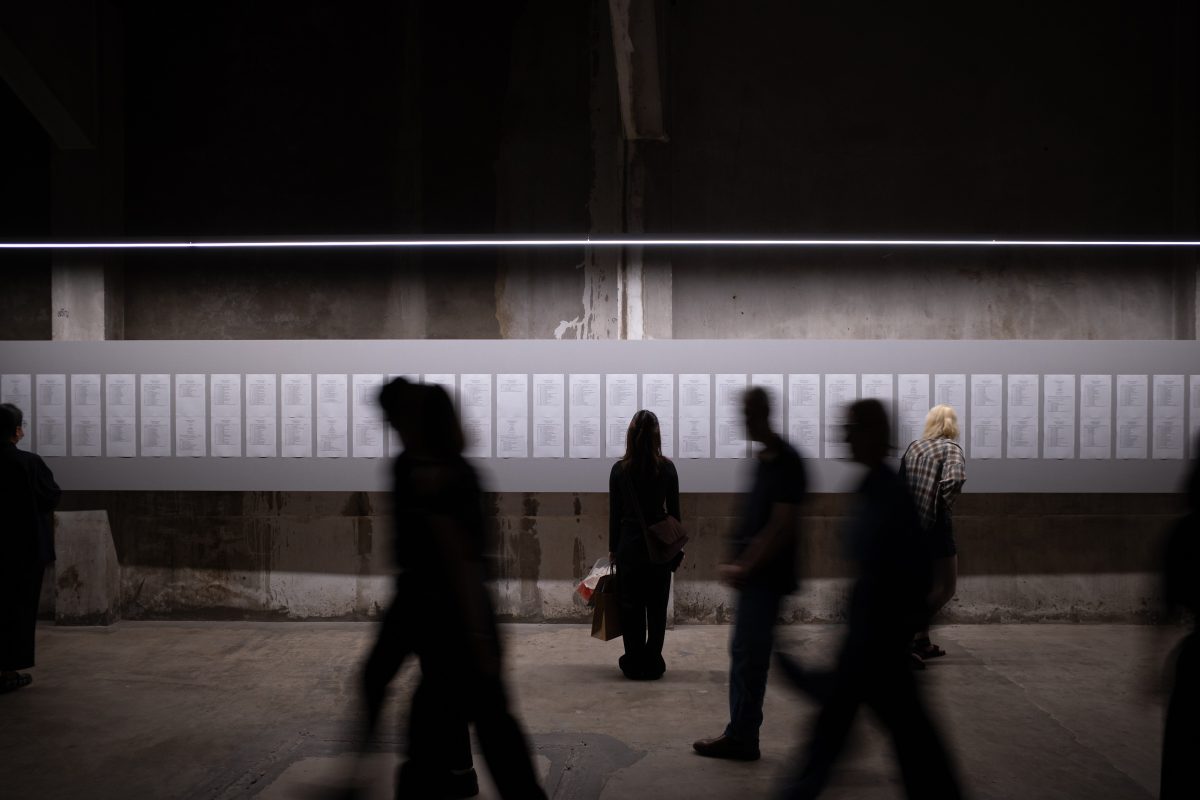
Credit Bruce Nauman, Mapping the Studio I (Fat Chance John Cage), 2001. Installation view, Bangkok Kunsthalle. © Bruce Nauman/Artists Rights Society (ARS), New York. Photo by Samatcha Apaisuwan The exhibition is organized by Dia Art Foundation. Courtesy of Bangkok Kunsthalle.