The World Meteorological Organization’s (WMO) State of the Global Climate 2025 report reveals that the period from 2015 to 2025 marked the warmest eleven consecutive years on record, posing significant challenges to global agriculture and food security. Thailand ranks 17th globally in vulnerability to extreme weather events according to the Climate Risk Index 2026, while the ND-GAIN Country Index places the country’s climate readiness at 123rd out of 192 nations. This gap between climate risk and preparedness underscores the urgency of climate action, particularly as World Bank projections indicate that, without additional proactive measures, climate-related impacts could reduce Thailand’s GDP by 7% to 14% by 2050.
These challenges are further intensified by an increasingly stringent international regulatory landscape. Global trade mechanisms, from the European Union’s Carbon Border Adjustment Mechanism (CBAM) and EU Deforestation Regulation (EUDR) to mandatory supply-chain greenhouse gas (GHG) reporting requirements across major economies such as China and Singapore, are reshaping the rules of international commerce. Global competitiveness no longer hinges solely on price and production costs; it now increasingly depends on credible decarbonization efforts, traceability, and environmental transparency.
Carbon Neutral Complex: Scaling a Low-Carbon Model Across the Value Chain
With more than seven decades deeply rooted in Thailand’s agro-industrial ecosystem, Mitr Phol Group has long recognized the importance of addressing climate change as a strategic business priority. Grounded in the understanding that the wellbeing of sugarcane farmers, employees, neighboring communities, business partners, customers, and consumers is closely intertwined with its long-term growth, Mitr Phol embeds sustainability into its core business practices in alignment with the United Nations Sustainable Development Goals (UN SDGs). By promoting economic growth while advancing environmental stewardship and social responsibility, the Group strengthens resilience across its entire value chain.
In 2022, Mitr Phol accelerated its climate commitments by setting a definitive goal to achieve Net Zero greenhouse gas emissions by 2050. This commitment took concrete form in 2023 when the Mitr Phol Dan Chang Complex in Suphan Buri Province became the first site in Thailand to be certified as a ‘Carbon Neutral Complex’ by the Thailand Greenhouse Gas Management Organization (TGO), a distinction it continues to uphold today.
Buntoeng Vongkusolkit, Chairman of Mitr Phol Group, stated: “From the outset, our founding principle has centered on ensuring that our operations improve the quality of life for everyone around us. This is why Mitr Phol places equal emphasis on economic, social, and environmental development. Driving an organization toward Net Zero requires progress across many dimensions, but it begins with building shared knowledge, understanding, and awareness among our people and communities. Our ‘Carbon Neutral Complex’ initiative serves as an essential foundation, helping employees recognize the importance of reducing emissions and encouraging them to rethink everyday processes so that decarbonization becomes embedded throughout our operations. This bottom-up shift is what turns our long-term Net Zero ambition into reality and extends its impact across our value chain. For Mitr Phol, genuine sustainability can only be achieved when people, society, and the environment thrive together.”
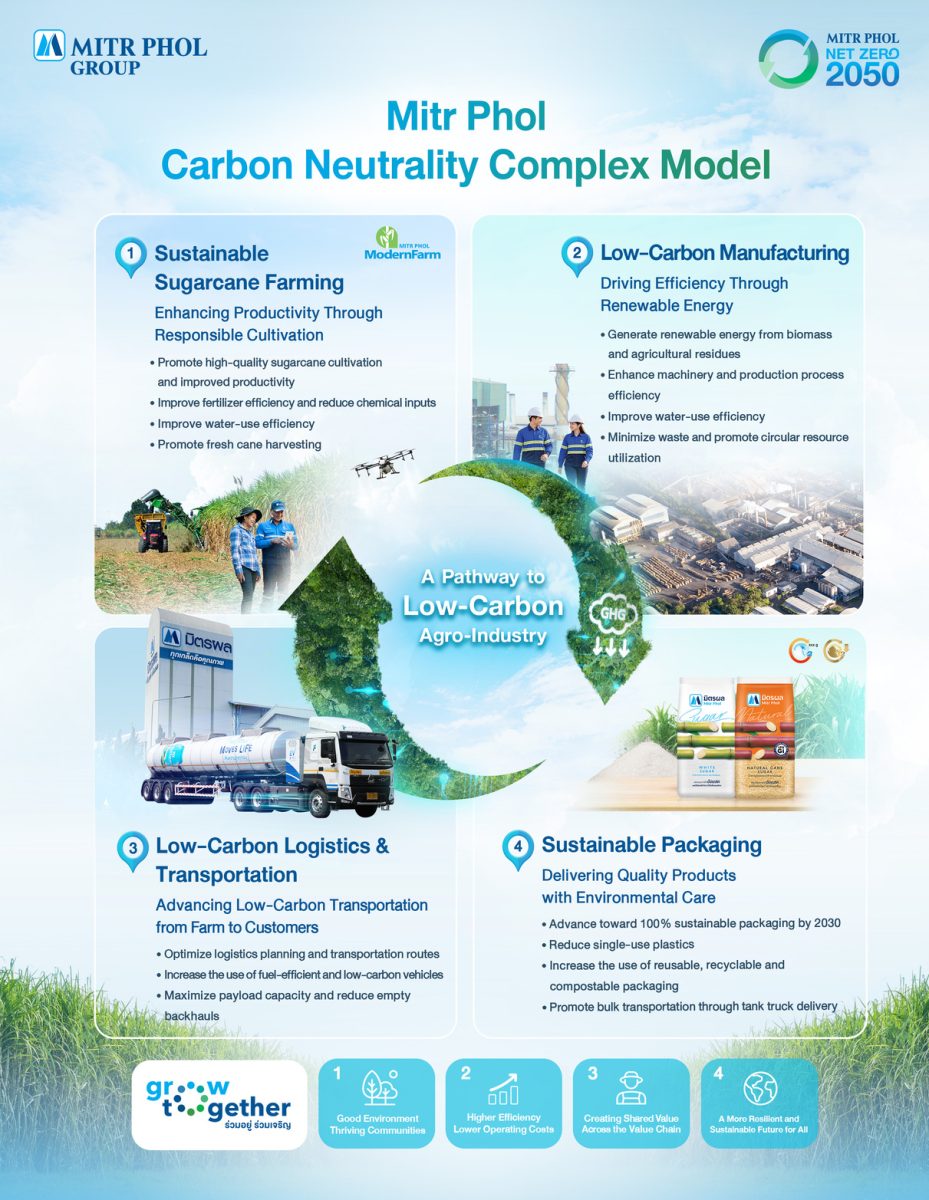
Mitr Phol Group is advancing its transition toward a low-carbon economy through comprehensive actions across its value chain, from upstream to downstream. At the source, the Group promotes environmentally responsible modern sugarcane cultivation under its Mitr Phol ModernFarm approach, aligned with internationally recognized sustainability standards and programmes, including Bonsucro and the VIVE Sustainable Supply Programme. At the industrial level, it expands the use of renewable energy while enhancing manufacturing efficiency through innovation and advanced technologies. Downstream, Mitr Phol strengthens its Green Chain and green logistics systems to promote sustainability across its value chain and business partnerships, while developing sustainable packaging that supports efficient resource use, minimizes environmental impacts throughout the product life cycle, and fosters sustainable consumption.
To date, three Mitr Phol sites have achieved Carbon Neutrality certification. Building on the model established at the flagship Mitr Phol Dan Chang Complex in Suphan Buri Province, the certification was expanded in 2026 to include the Mitr Phol Phu Khiao Complex in Chaiyaphum Province and the Mitr Phu Viang Sugar Mill in Khon Kaen Province. The Group continues to scale this operational model across its remaining facilities nationwide.
Mitr Phol’s Carbon Neutral Complex model demonstrates that Thailand’s agro-industrial sector has the ability to adapt, modernize, and proactively respond to climate risks. By transforming environmental challenges into strategic drivers for internal engagement, operational efficiency, and long-term competitiveness, the sector can thrive in a changing global economy.
However, the transition to a low-carbon economy cannot be achieved by any single organization alone. It requires broad and committed collaboration across the ecosystem, from farmers, businesses, and industrial players to government agencies and consumers. By working together, stakeholders across the value chain can transform shared challenges into shared opportunities and create a more resilient and sustainable future for generations to come.