Heavy AI Investment, Zero Transformation: Why Isn’t It Paying Off? Overcoming Patchwork AI by Redesigning Workflows and Decision-Making for the AI-Native Enterprise
AI investments fail to drive bottom-line results until organizations resolve their underlying structural flaws.
The adoption of AI is expanding rapidly among organizations, covering tasks ranging from language translation and report summarization to document creation and the elimination of repetitive work. These applications are helping teams work faster and with greater agility. Yet, from a broader business perspective, executives are left asking a critical question: why isn’t this growing investment in AI translating into tangible business results?
The issue is not simply whether AI is capable enough, but how it exposes the limitations that already exist within an organization. Data scattered across multiple systems, overly complex and time-consuming handoffs, slow approval processes, and unclear roles and responsibilities are all brought to light. In the past, companies may have addressed these issues by adding headcount or resources as a quick fix. However, as AI scales, these underlying structural bottlenecks can quickly bring transformation efforts to a halt.
Patchwork AI Adoption: Widespread Tools, Uncoordinated Business Goals
Today, many organizations deploy AI in isolated pockets to address department-specific needs, with sales teams using it to summarize insights, finance for document verification, and operations for planning. Using AI to solve problems within individual departments is a good starting point, as it allows organizations to quickly see the benefits. But when departments operate in isolation rather than working towards a shared strategic goal, AI becomes little more than a localized efficiency tool rather than an engine for enterprise-wide transformation. ABeam Consulting calls this phenomenon Patchwork AI Adoption, a fragmented approach in which companies accumulate AI projects without a clear, unified vision of how technology can reduce costs, increase revenue, or improve executive decision-making.
Ms. Supreeda Jirawongsri, Managing Director of ABeam Consulting (Thailand) Co., Ltd., highlighted this issue, noting that “AI doesn’t automatically solve organizational problems; it acts as a bridge that reveals where our data is disconnected, where workflows are redundant, or where decision-making stalls. If these bottlenecks remain unaddressed, AI investments will only yield task-level results, not impact the bottom line or overall performance.”
Consequently, measuring success by the number of pilot projects, deployed systems, or active user licenses is no longer sufficient. These metrics show the scale of adoption, but they do not demonstrate whether AI is having a measurable impact on the P&L. To generate tangible business value, the time saved through AI must translate into lower operating costs, higher output, or faster and more accurate decision-making.
Becoming an AI-Native Enterprise: Transforming AI into a Decision-Making Support System
Procurement provides a clear example. AI can process invoices, categorize documents, and carry out preliminary checks, reducing repetitive work and accelerating individual steps in the process. However, it cannot address the broader business challenge or improve the procurement process as a whole if data remains isolated across procurement, finance, warehousing, logistics, and suppliers.
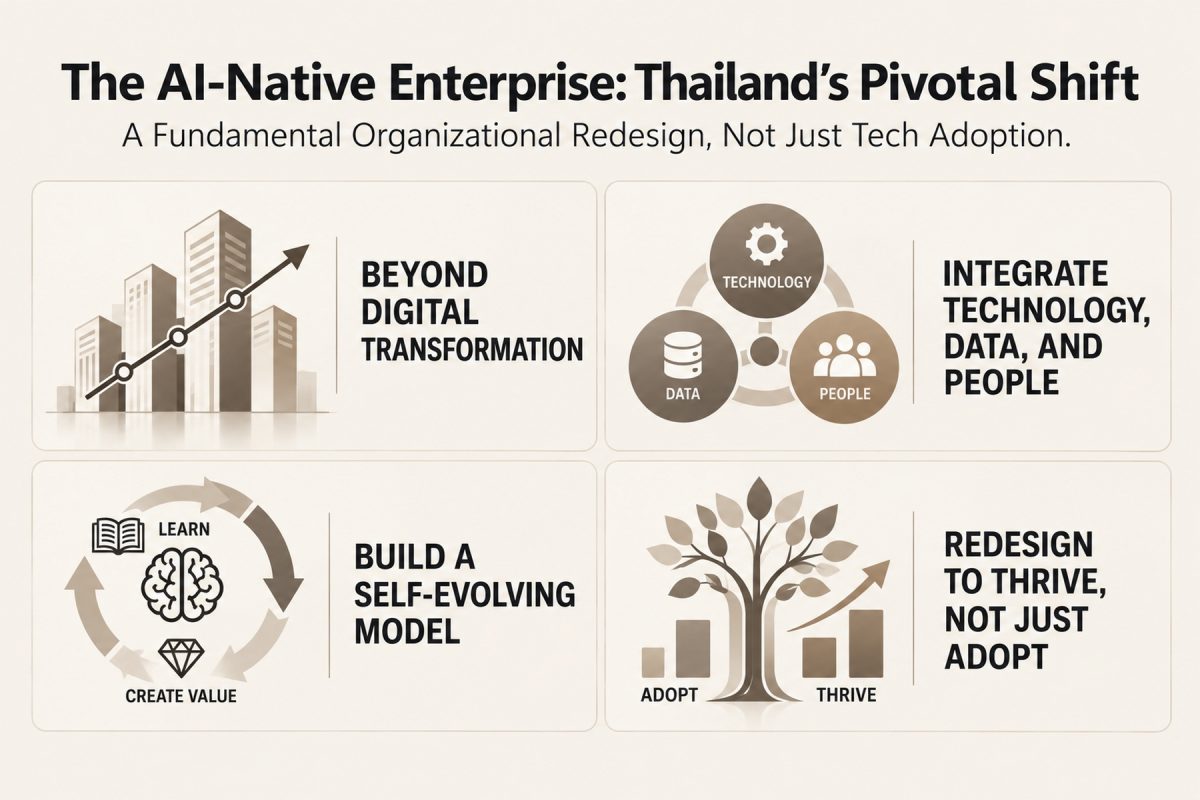
True transformation happens when organizations undertake an end-to-end redesign of their operations, enabling business units to work from a single source of truth, establishing clear accountability, and positioning AI to process data and provide insights and strategic options for better decision-making. Executives and business leaders remain responsible for making important decisions, taking into account the specific circumstances and objectives of the business. What sets an AI-Native Enterprise apart is not how much technology it has, but its ability to systematically align data, processes, and decision-making with business objectives.
Start Small, Scale Big: Restructuring Through High-Impact Priorities
Organizations do not need to launch massive, company-wide rollouts overnight. Instead, they can target a single critical cross-functional workflow, such as procurement, inventory planning, or financial closing, and drive its transformation from end-to-end.
Before getting started, leaders must clearly define the desired business outcome, which processes need to be improved, and which KPIs should be used to measure success. This clarity prevents companies from getting lost in a sea of pilot projects that may appear successful in the short-term but fail to deliver results at the enterprise level.
To ensure that transformation extends beyond simply deploying tools, ABeam Consulting utilizes the AI Native Target Operating Model (AI Native TOM), a framework that sets the overall transformation to connect business objectives, organizational structure, workflows, data architecture, systems, and governance. This enables organizations to clearly see both business and technology transformation and pinpoint where AI should be introduced to support operations and achieve measurable results.
From Operations Hub to Decision Hub
Many organizations have built their competitiveness on operational efficiency, speed, and cost advantages. However, as AI takes over routine tasks and repetitive processing, these strengths may no longer be sufficient in creating long-term value. Organizations must evolve from being an “Operations Hub” to becoming a “Decision Hub”, using data to support analysis and decision-making, create strategic advantages, and redesign workflows for sustainable growth.
“The question moving forward isn’t how much work an organization can produce, but how well it helps the business make better decisions and create new value. Companies that proactively evolve their strategic roles today will secure a decisive long-term advantage,” concluded Ms. Supreeda.
In an era where AI technology is becoming a commodity accessible to all, competitive advantage will not belong to those with the most tools, but to those that use AI to address structural weaknesses and rethink how people, processes, and technology work together. Becoming an AI-Native Enterprise is therefore not simply the next phase of digital transformation, but a strategic imperative for redefining corporate relevance and maintaining long-term competitiveness.