
As algorithms play an increasingly important role in driving businesses and shaping people’s way of life, the true value of technology can no longer be measured by intelligence alone. It must also be founded on safety, fairness, and respect for human rights. At AI Governance Week 2026, during the session “Connecting the Right Dots: Red Teaming for Robust and Responsible AI”, organized by the Electronic Transactions Development Agency (ETDA), Mr. Montri Stapornkul, Head of Data Privacy Division at True Corporation Plc., shared True’s perspective as a Thai tech company moving toward becoming an AI-First Organization. He emphasized that Responsible AI is not merely a regulatory framework, but an essential part of conducting business responsibly. This encompasses the design and operation of AI systems, the data used in their processing, and the assessment and management of potential impacts on people and society.
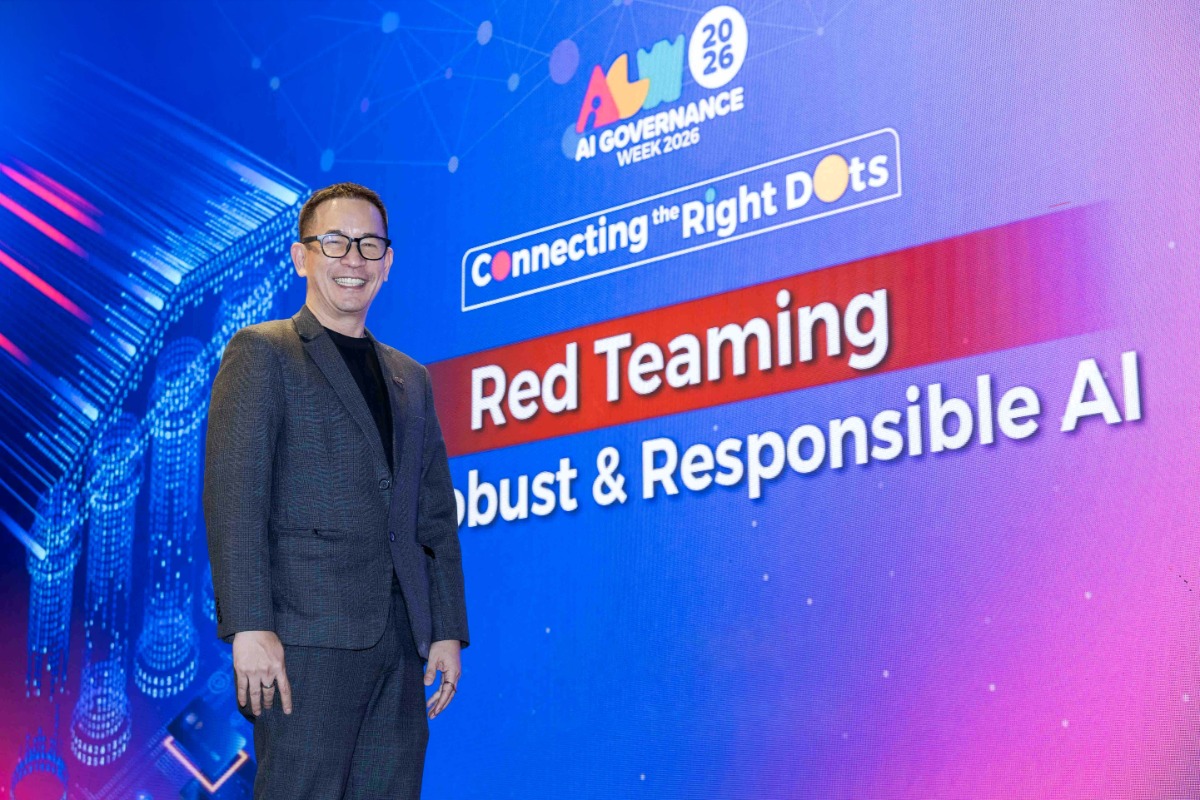
Beyond Accuracy: AI Must Be Safe, Fair, and Responsive to the Thai Context
AI safety should not be viewed as a constraint on innovation, but as the foundation that enables organizations to develop and deploy technology with confidence without causing discrimination, violating privacy, or affecting people without appropriate safeguards and clear human accountability. AI testing must therefore go beyond technical accuracy. It should cover data quality; risks related to bias and fairness; explainability of outcomes; privacy and security; risks of misuse; and fallback mechanisms for situations in which a system does not perform as expected. Large language models, or LLMs, in particular, should not be assessed solely against global standards. They must also be tested against the Thai language, Thai laws, culture, social context, and real-world use cases in Thailand.
“The key question is not simply whether AI works, but whether it works appropriately, safely, and fairly in the context in which it is actually used. For Thailand, we must also be able to answer whether AI understands and performs appropriately within the context of Thai people”, Mr. Montri emphasized.
True CyberSafe, A Model Innovation for Stronger Customer Protection Against Cyber Threats
Another important dimension of Responsible AI is designing services that enable everyone to benefit from technology and receive protection in an inclusive and equitable manner. True CyberSafe is one example of how technology and AI can be used to develop services with safety, trust, and social responsibility at their core. Its AI can detect more than 7.5 million suspicious links per day and provides coverage for more than 50 million users. The service offers basic network-level protection against cyber threats at no additional charge, ensuring that every customer can access essential protection. Customers who require a higher level of protection can also choose additional services that best suit their needs.
Building AI Sovereignty for Informed and Confident Technology Choices in Thailand
True also places importance on building “AI Sovereignty”, the country’s capability to understand, select, test, and govern AI in a manner aligned with Thailand’s context and national interests. This does not mean that Thailand must develop every technology independently or restrict innovation from around the world. Rather, it means having the knowledge and readiness to understand, test, govern, and make careful decisions about the use of AI, while recognizing the limitations, risks, and technology dependencies that may affect the country over the long term. Building this capability requires collaboration among regulators, the business sector, academia, and technology providers. Together, they can develop practical standards; testing and evaluation systems that reflect the Thai language, laws, culture, and social context; and experimental environments or sandboxes that allow all sectors to learn from real-world implementation and develop innovation safely.
“AI Sovereignty does not mean rejecting global technologies. It means ensuring that Thailand has the capability to understand, select, and govern those technologies with informed judgment. A country that can use AI with confidence is not necessarily the country with the most technology, but the country that understands how the technology works, where its risks lie, and how it should be applied for the benefit of people,” Mr. Montri said.
For True, personal data protection and Responsible AI are not merely matters of legal compliance. They are guiding principles for governing technology throughout its entire lifecycle from design, development, and testing to real-world deployment so that innovation can grow alongside safety, fairness, and trust. In a world where AI increasingly influences people’s lives and decisions, technology leadership is not measured only by who can develop AI faster or make it more intelligent. It is ultimately measured by who can build technology that people trust and use it to move society forward responsibly and sustainably.

Symbol: TRUE