More than 70 per cent of Thai SMEs surveyed are implementing artificial intelligence (AI) — above the regional average — while more than 80 per cent are planning to expand overseas within the next two to three years
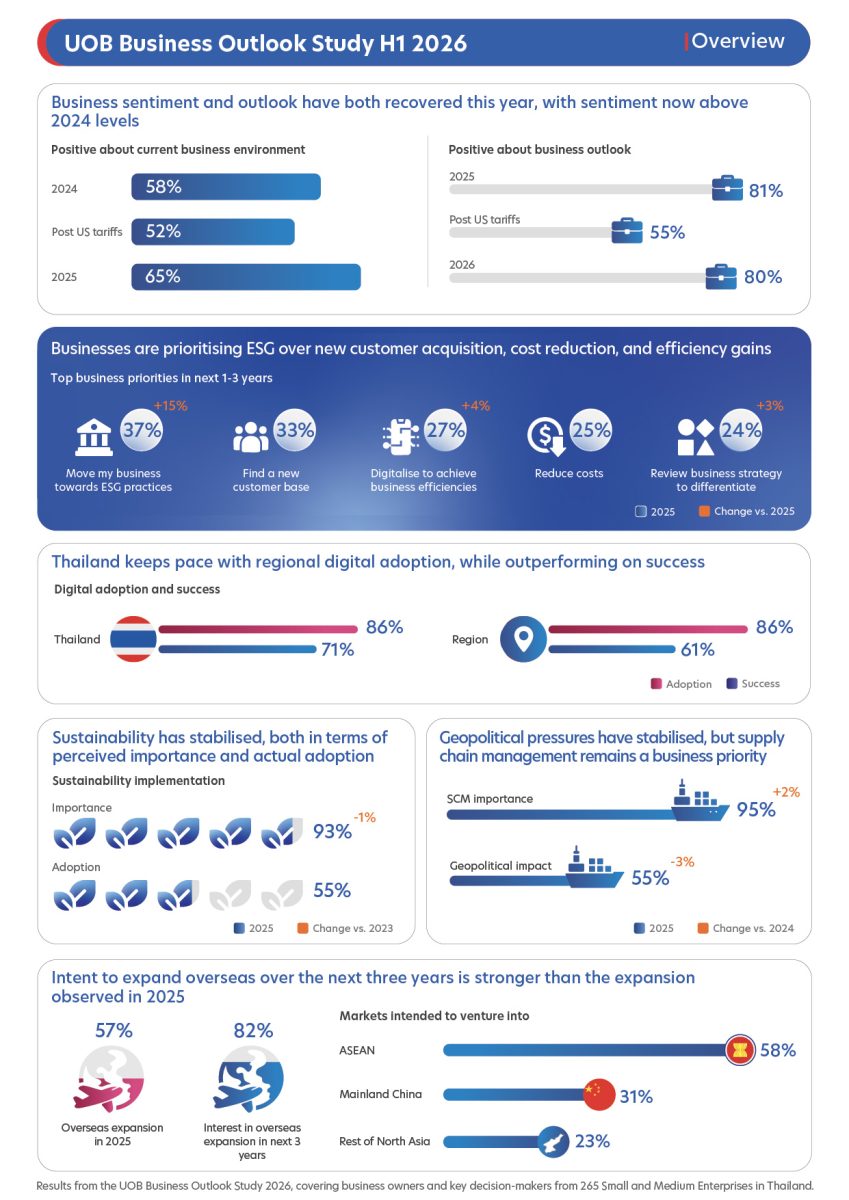
Thai small and medium-sized enterprises (SMEs) are responding to rising costs and geopolitical uncertainties by rebuilding how they operate, adopting AI at rates above the regional average, restructuring supply chains and using ASEAN expansion to spread risk, according to the UOB Business Outlook Study 2026 (H1 2026): Thailand.
Reflecting the accelerated pace of change, UOB will now conduct the study twice a year – the first time in its seven-year history – to better capture rapidly evolving economic and geopolitical conditions. This inaugural first-half edition surveyed 265 business owners and senior decision-makers across key industries nationwide.
Technology adoption ahead of the region
More than seven in 10 Thai SMEs surveyed are implementing AI, above the regional average, while more than eight in 10 have adopted digital solutions. Businesses are deploying these tools to boost productivity, manage costs and accelerate decision-making, underscoring a shift from experimentation to operational necessity. Among businesses that have adopted AI, 58 per cent reported cost reductions and 44 per cent reported productivity gains, indicating that AI is already delivering measurable business value.
Cost pressure remains the dominant concern
Rising operating costs remain the top concern for Thai SMEs surveyed, followed by uncertainty in ASEAN and Greater China markets, high interest rates and slower economic conditions. The pressure is most acute in sectors with high operating expenses and complex supply chains, such as manufacturing, construction and consumer goods.
Despite these pressures, businesses are prioritising long-term competitiveness over short-term cutbacks, with ESG (37 per cent), customer acquisition (33 per cent) and digitalisation (27 per cent) ranking ahead of cost reduction (25 per cent) among their top business priorities over the next one to three years.
Mrs Vira-anong C. Phutrakul, Deputy CEO and Country Function Head of Wholesale Banking, UOB Thailand, said, “Thai businesses are operating in an increasingly complex environment, where cost pressure, supply chain disruption and geopolitical uncertainties are no longer temporary challenges. In response, businesses are building resilience into the way they operate, invest and expand. This means strengthening supply chains, using technology more purposefully and looking at ASEAN not only as a growth market, but also as a way to diversify risk.”
Supply chains restructured, with China still central
More than nine in 10 Thai SMEs surveyed now prioritise supply chain management. Among them, 75 per cent plan to diversify suppliers, while 53 per cent are looking to expand manufacturing within ASEAN.
Around one-third are accelerating “China Plus One” strategies, relocating parts of their production to alternative markets to reduce concentration risk. However, diversification remains constrained by regulatory complexity, higher input costs and gaps in local supplier capacity, with China continuing to play an integral role in regional supply chains.
ASEAN expansion as risk strategy, not just growth play
More than eight in 10 Thai SMEs surveyed are considering expansion overseas in the next two to three years, with ASEAN being the preferred destination. Singapore, Vietnam and Malaysia were cited as key markets, supported by their growth potential and role in supply chain diversification.
While revenue growth remains the primary driver, businesses increasingly view regional expansion not only as a means to access new demand, but as a way to reduce concentration risk and strengthen long-term competitiveness.
Sustainability tested by cost pressure — but energy efficiency holds
Nine in 10 Thai SMEs surveyed recognise the value of sustainability, and 94 per cent are prioritising energy efficiency initiatives, even as broader implementation is tested by cost pressure. This suggests that businesses are focusing on measures that deliver clear returns, such as reducing energy consumption, optimising usage through digital tools, and adopting solutions such as solar and LED, while deferring those that do not yet show clear returns.
Mrs Vira-anong added, “The companies that adapt their supply chains, use technology to raise productivity and manage energy more efficiently will be better positioned to compete. UOB supports businesses at each of these decision points through our regional ASEAN network, FDI advisory capabilities and sustainable financing solutions, helping them navigate uncertainty, build resilience and capture growth opportunities across ASEAN.”
The UOB Business Outlook Study 2026 (H1 2026): Thailand forms part of UOB’s regional study of business sentiment and priorities across ASEAN and Greater China. Read the full report here.