In the early morning hours of Chanthaburi Province, the first rays of sunlight slowly illuminate vast stretches of fruit orchards. Large durians hang heavily from the branches, their distinctive aroma drifting gently through the breeze.This scene signals the return of the durian season once again. Today, Thailand’s durian industry no longer relies solely on export markets, as domestic consumption continues to grow steadily.At the same time, ongoing government support policies, combined with the rapid expansion of e-commerce — particularly live commerce — alongside advancements in logistics innovation, are transforming the entire ecosystem of Thailand’s durian industry. These developments are reshaping everything from production and sales models to distribution channels and the overall market structure.Durian’s Golden Era Sparks Rising Consumption Across Thailand
The year 2026 is being hailed as a golden year for Thailand’s durian industry, with total production projected to reach approximately 1.89 million tons — an increase of 21.4% compared to the previous year. Chanthaburi Province, the country’s primary durian-producing region, accounts for more than 60% of the nation’s total output, creating a vibrant atmosphere throughout the harvest season across local orchards.
While Thailand’s durian industry has traditionally relied heavily on export markets, the government is now actively promoting domestic consumption, leading to the emergence of a new market structure in which 70% of production is allocated for export and 30% for domestic distribution.
To accommodate rising production volumes, the government has continued to introduce support measures aimed at strengthening the long-term growth of Thailand’s durian industry. The Ministry of Agriculture and Cooperatives, in collaboration with the Ministry of Commerce, has launched the 2026 Fruit Management Plan through eight proactive measures designed to increase domestic consumption to 550,000 tons.
At the same time, the Ministry of Commerce has signed a partnership agreement with TikTok, alongside allocating more than 6.5 million baht in support funding to help over 20,000 small and medium-sized local online entrepreneurs enter the digital marketplace.
In addition, Deputy Prime Minister and Minister of Commerce Mrs. Suphajee Suthumpun has personally joined live-streaming sessions from fruit orchards to promote durians alongside well-known influencers. As a result, “live streaming directly from the orchard” has become a common sight during Thailand’s fruit season.
Across orchards nationwide, online sellers now set up real-time live broadcasts showcasing the harvesting process and freshly opened durians straight from the farm, accompanied by energetic sales pitches that attract audiences from both Thailand and overseas. A single live-streaming session can generate sales worth as much as 15 million baht within just three hours, while attracting more than 500,000 viewers.
Live-commerce sales have rapidly become a key channel connecting farmers directly with consumers, making it easier for buyers to access products straight from the source while enabling farmers to expand their market reach and increase income more effectively.
“In the past, once the durians were ready for harvest, we simply sold them to middlemen. Farmers had little power to set their own prices. Today, however, there are far more sales channels available. Many growers have turned to live-streaming to sell directly to consumers, and it has made us realize just how strong demand for durian is among Thai consumers. Online orders continue to rise, and our incomes are significantly better than before,” said Somjai Tutisakhon, a veteran durian farmer with more than 40 years of experience, smiling proudly.
J&T Express Proactively Prepares for Peak Delivery Demand
The sharp rise in durian production, coupled with the continuous surge in orders generated through live-commerce sales and rapidly expanding demand from both domestic and international markets, is emerging as a major challenge for Thailand’s durian industry. As durians are highly sensitive to transportation conditions and require fast delivery, the sudden influx of orders generated during live-streaming sessions has pushed traditional logistics systems to their limits, making them increasingly unable to support the industry’s rapid evolution.
Sunantha Petchmee, a durian entrepreneur with more than 30 years of experience in the trade, explained that while her business once relied primarily on offline sales channels, it has now fully transitioned into live-commerce operations. During last year’s durian season, her business handled an average of 4,000–7,000 parcel shipments per day. This year, after collaborating in a live-streaming session with one of Thailand’s leading influencers, a single broadcast generated nearly 60,000 orders.
“The biggest challenge is that orders from live-streaming sales flood in simultaneously. We have to dispatch products as quickly as possible, but manpower is often insufficient. Delays in packaging and transportation, along with concerns over damage during delivery, frequently led to customer complaints and product claims,” Sunantha said, adding that “after partnering with J&T Express, those issues no longer occurred.”
As its role within the durian supply chain continues to deepen, J&T Express has evolved beyond the conventional reactive logistics model by developing a fully integrated support system tailored specifically for Chanthaburi’s durian industry. This year, the company’s Eastern Region team established a dedicated task force to support the durian season, covering transportation capacity planning, workforce preparation, proactive operational management, and after-sales support. The initiative is designed to deliver fast, secure, and highly efficient services for major clients, farmers, and local SMEs throughout the region.
At present, the durian business in Chanthaburi operates 24 hours a day. There is no longer any distinction between daytime and nighttime operations. Orders from live-streaming sales can spike at any moment, while local sellers constantly need to replenish stock. That is why we deploy teams in advance and coordinate operations in real time. Parcels are collected directly from the source and transported straight to sorting centers without passing through branches, ensuring that not a single durian is left behind during transit,” said Natcha Sook-anun, Marketing Network Manager for J&T Express’ Eastern Region.
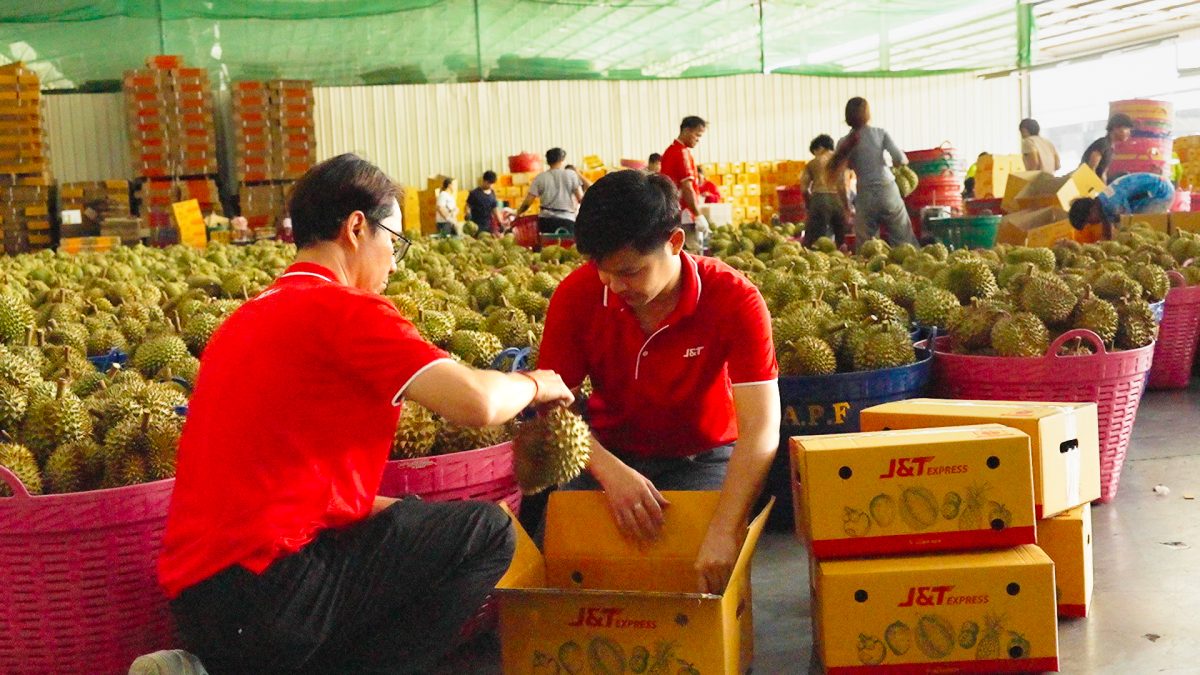
She further explained: “Almost every seller handles large-scale durian sorting operations, so we have assigned dedicated on-site teams accordingly. Large sellers are supported by teams of more than 30 staff members, while smaller sellers are assigned teams of three to four personnel. These teams include customer managers, operations supervisors, quality control officers, customer service representatives, and sorting staff. If any issue arises, it can be communicated and resolved immediately on-site.”
Since mid-April, the volume of durian parcel shipments handled by J&T Express in Thailand’s Eastern Region — particularly in Chanthaburi and Rayong provinces — has risen sharply. Between April 15 and 30 alone, durian parcel intake volumes in Chanthaburi increased by as much as 60% compared to the same period last year.
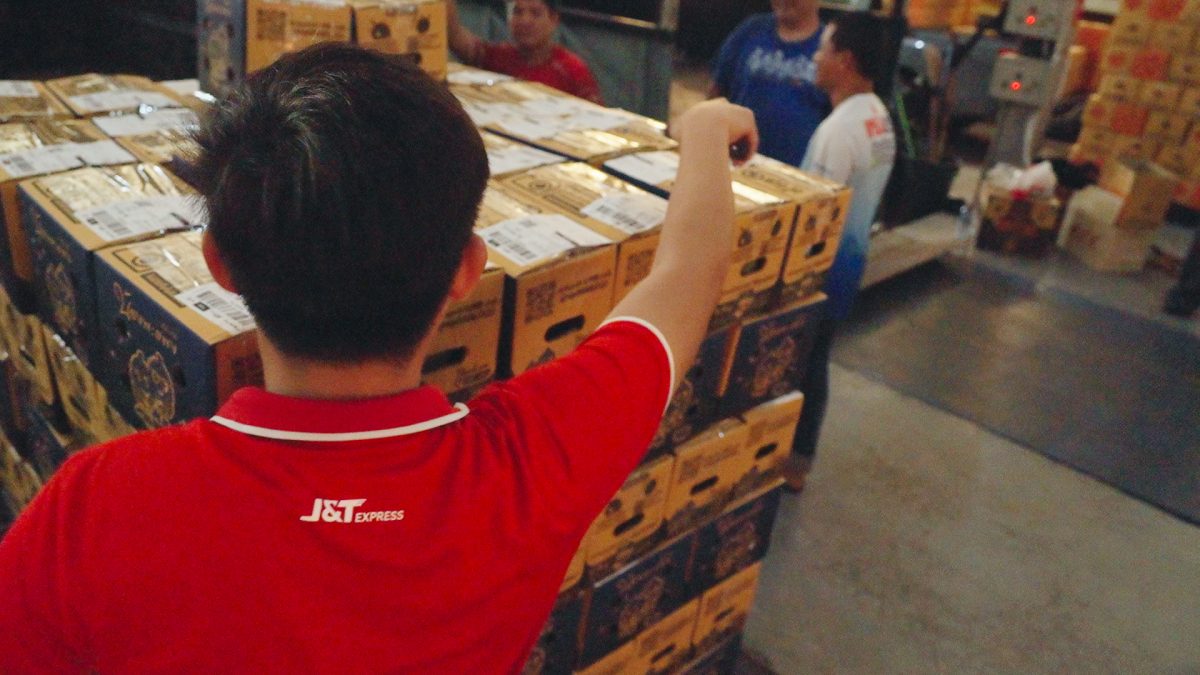
To prepare for the peak sales season of Monthong durians between late May and June, J&T Express has implemented 15 dedicated durian parcel collection routes across the Eastern Region, while also preparing more than 100 standby trucks. In addition, the company has extended parcel acceptance hours at its distribution centers until midnight to efficiently accommodate the surge in transportation demand during the peak season.
“The J&T Express team has truly supported us every step of the way. Our store simply didn’t have enough manpower, so they immediately deployed additional staff to assist us. The J&T Express team came directly into our warehouse to help pack products, process parcel information, scan, and sort shipments before loading them onto trucks waiting outside the facility,” said Sunantha Petchmee with deep appreciation.
She added, “A true partner is someone who is willing to share the pressure during the peak season of the business. They help manage every logistics and supply chain challenge, allowing us to fully focus on improving product quality and maximizing our live-commerce sales efforts.”
Logistics Transformation Redefining the Durian Industry Ecosystem
The comprehensive advancement of logistics systems is no longer simply about resolving delivery and distribution challenges. Through the strong collaboration between the public sector, which sets strategic direction, and the private sector, which continues to drive innovation and operational development, it is fundamentally transforming Thailand’s durian industry ecosystem. This evolution is turning rising production volumes into tangible economic value, enabling increased output to translate into sustainable income growth.
In the past, Thailand’s durian industry relied heavily on only a limited number of export markets, with products often passing through multiple layers of intermediaries. This extended supply chain increased costs at every stage, while continuously squeezing profit margins for farmers and small-scale entrepreneurs. Today, however, driven by supportive government policies, the rapid expansion of live commerce, and the modernization of logistics infrastructure, a new supply chain model has emerged — seamlessly connecting orchards, traders, live-streaming platforms, logistics networks, and consumers across both domestic and international markets.
This transformation has significantly shortened distribution channels, accelerated product circulation, and created a more efficient and resilient ecosystem, generating stronger and more sustainable income opportunities for stakeholders throughout the entire value chain.
Thailand is accelerating a comprehensive, end-to-end strategy to strengthen its durian industry across the entire supply chain. In the production sector, efforts are centered on advancing Good Agricultural Practices (GAP) while establishing dedicated quality control centers to elevate standards and ensure consistent quality from the earliest stages of cultivation. In the processing sector, the government continues to drive the development of value-added durian products, including frozen durian and other processed innovations, to enhance product value, diversify market opportunities, and reduce exposure to market volatility. Meanwhile, on the commercial front, Thailand is reinforcing the resilience of its key export markets—particularly China—while actively stimulating domestic consumption to foster a more balanced, efficient, and sustainable supply-demand ecosystem.
At the same time, logistics systems have evolved far beyond their traditional role as transportation enablers. Today, they serve as a critical mechanism for balancing supply and demand across both domestic and international markets, while acting as a strategic force in enhancing the competitiveness of the entire industry. Modern logistics not only help remove cross-border trade constraints, enabling Thai durians to access global markets with greater efficiency, but also strengthen nationwide distribution networks to meet continuously expanding consumer demand. This enhanced connectivity helps stabilize prices during peak harvest periods and minimizes the risks of oversupply, spoilage, and market price depreciation.
Today, the capacity to manage large-scale shipping volumes and maintain precise delivery timelines has become a defining benchmark of a production region’s competitiveness, as well as a key indicator of each business’s ability to fulfill growing market demand.
From the vast durian orchards of Chanthaburi to the bustling night markets of Bangkok and dining tables across the globe, the journey of a single durian tells the story of a remarkable transformation unfolding within Thailand’s durian industry. Driven by abundant harvests, forward-looking government policies, and the comprehensive modernization of logistics infrastructure, Thai durian is entering a new era of sustainable growth—one where export markets remain strong, domestic demand continues to flourish, and farmers are empowered to achieve stable, long-term prosperity.
About J&T Express
J&T Express (HKEX: 1519) is a global logistics service provider with leading express delivery businesses in Southeast Asia and China, the largest and fastest-growing market in the world. Founded in 2015, J&T Express’ network spans thirteen countries, including Indonesia, Vietnam, Malaysia, the Philippines, Thailand, Cambodia, Singapore, China, Saudi Arabia, the UAE, Mexico, Brazil, and Egypt. Adhering to the “customer-oriented and efficiency-based” mission, J&T Express is committed to providing customers with integrated logistics solutions through intelligent infrastructure and digital logistics network, as part of the global strategy to connect the world with greater efficiency and bring logistical benefits to all.
For further information and latest updates, do like and follow J&T Express Thailand:
- Website: www.jtexpress.co.th
- Facebook: J&T Express Thailand
- Instagram: @jntexpressth
- X: @jntexpressth
- TikTok: @jntexpressth
- Application: J&T Thailand, as well as Call center: 1470