
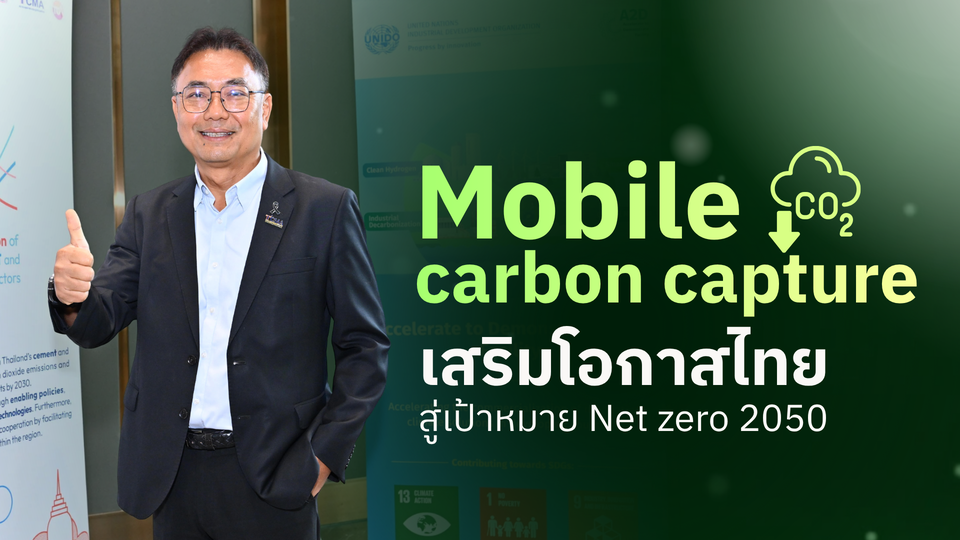
In an era defined by the global climate crisis, heavy industries like cement manufacturing are often cast as primary carbon emitters. However, Thailand is rewriting that narrative. The recent debut of the “Mobile Carbon Capture Unit”—the first of its kind in the region—marks a pivotal “Game Changer” in the nation’s journey toward a Net Zero future and establishes Thailand as a formidable leader in global green technology.
The “Mobile” Advantage: A Strategic Approach to Decarbonization
The cornerstone of this initiative is flexibility. Traditional Carbon Capture and Storage (CCS) systems for large-scale plants typically require massive capital expenditure and carry high technical risks. By leveraging advanced Canadian technology—supported by the Government of Canada and the United Nations Industrial Development Organization (UNIDO)—Thailand has developed a mobile unit capable of testing carbon capture in real-world production environments.
This mobile capability allows the unit to be integrated into various production lines across the country to gather empirical data on how solvents absorb carbon from flue gases. This data is crucial for designing large-scale, permanent capture systems with precision, significantly reducing investment risks and maximizing operational efficiency.
Beyond Capture: Turning Waste into Renewable Fuel
Thailand’s vision extends beyond merely “capturing” and “storing” carbon. The cement industry is pioneering Carbon Capture and Utilization (CCU) by converting captured CO2 into a valuable resource. Instead of underground sequestration, the captured carbon is synthesized with hydrogen to produce Methane Gas.
This synthesized methane is then recirculated into the cement kilns as a clean fuel source. This closed-loop mechanism does more than just lower emissions; it reduces Thailand’s dependence on energy imports and fosters a self-reliant, sustainable energy ecosystem.
A Global Benchmark: Thailand as the 21st Industrial Cluster
These advancements have placed Thailand firmly on the global map. The World Economic Forum (WEF) has recognized Thailand as a “Transitioning Industrial Cluster” sandbox—the first in Thailand, the third in ASEAN, and the 21st in the world. As the current President of the ASEAN Federation of Cement Manufacturers (AFCM), Thailand is now poised to transfer this technological “know-how” to its regional neighbors.
Furthermore, the industry is preparing to launch LC3 (Limestone Calcined Clay Cement), a next-generation low-carbon cement that emits significantly less CO2 than existing products. This move coincides with an ambitious goal to phase out the production of traditional Ordinary Portland Cement (OPC) in favor of sustainable alternatives.
The Path Forward
The transformation of Thailand’s cement industry is more than a response to global environmental trends; it is the construction of a new “Green Economy.” By lowering the carbon footprint of its industrial products, Thailand ensures its exports remain competitive in a global market increasingly governed by carbon taxes and sustainability standards.
The “Mobile Carbon Capture” unit is more than just a piece of machinery; it is a symbol of international cooperation and Thai leadership, proving that heavy industry and environmental stewardship can—and must—thrive together.