
CBRE Thailand, a leading international property consultant, today released its comprehensive 2026 outlook for the Thai real estate market. The firm forecasts a year where developers and investors must strategically balance risk and reward amid persistent market uncertainties.
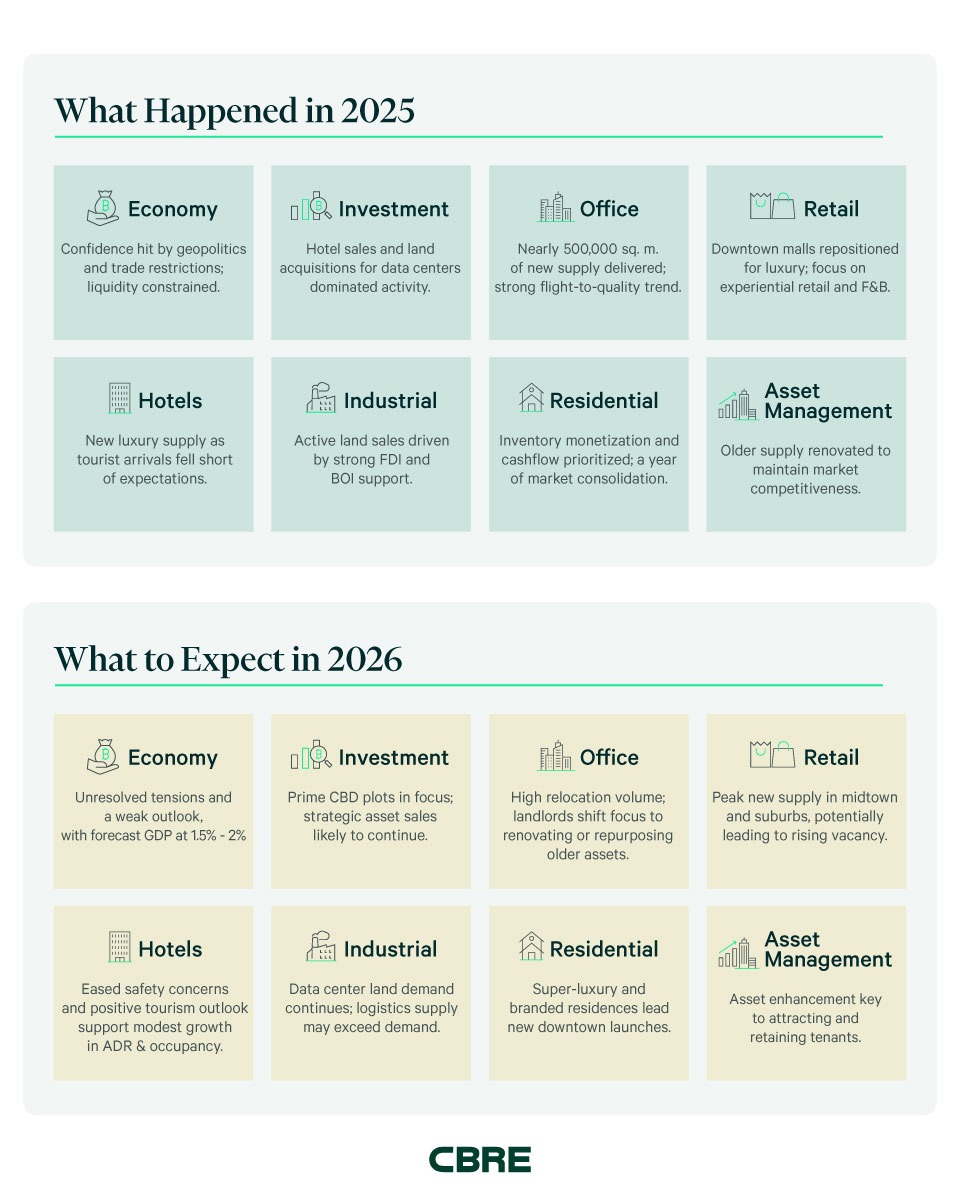
“Thailand’s real estate landscape continues its dynamic evolution, demanding a strategic and agile approach to investment and development,” stated Ms. Roongrat Veeraparkkaroon, Managing Director of CBRE Thailand. “Our analysis indicates that while some sectors will experience continued pressure, others are well-positioned for robust growth, driven by shifting consumer behaviors, focused government initiatives and broader global dynamics. Adaptation and innovation will be crucial for success.”
Retail Sector: Navigating Cautious Sentiment with Experiential Focus
Bangkok’s diverse retail market, ranging from expansive urban malls to community-centric spaces, sees developers actively investing in new projects and revitalizing existing assets to meet changing consumer lifestyles.
However, total retail supply reached 8.25 million square meters in 2025, with an additional 0.3 million square meters slated for completion in 2026. This new supply growth is projected to outpace tenant absorption, causing average occupancy rates to soften to below 90%.
Roughly 75% of this new supply is concentrated in midtown and suburban locations, shifting the competitive landscape towards residential neighborhoods where consumers are often more price-sensitive.
Ms. Chotika Tungsirisurp, Head of Consulting and Research at CBRE Thailand, revealed that “Strong interest from international retailers, particularly in F&B and fashion, continues to underscore Bangkok’s appeal for experiential spending. The city remains a regional F&B capital, driving sustained growth in coffee and restaurant market entries. Fashion retail, especially international brands from Europe, view Bangkok as a high-reward destination. In 2025, China accounted for the highest percentage of new foreign brands (20%), followed by Japan and Europe (both at 18%).”
Hospitality Market: Competition Meets Targeted Growth
Despite a challenging 2025 with fewer than 33 million international tourist arrivals, Thailand is well-positioned to attract visitors seeking medical care, wellness services and leisure travel, assuming improved stability and sentiment.
The country holds considerable potential for high-spending tourists in the expanding medical, wellness and MICE markets. Instilling confidence in safety and delivering value to short-haul international tourists will also be vital. The Tourism Authority of Thailand (TAT) forecasts 36.7 million visitors for 2026, with these elements central to achieving this target.
“Bangkok anticipates an influx of more than 4,300 keys in 2026, primarily within the upscale and luxury segments, though midscale products will continue to dominate the total supply at 43%. While this new supply will heighten competition, it is expected to positively impact performance, with occupancy projected to climb by up to 2 percentage points and RevPAR by 3%-4%. Although room rate growth may be somewhat limited by new supply, currency strength and regional competition, the shift toward higher-end offerings should positively influence overall ADR,” Ms. Chotika added.
Hotel operators are focusing beyond traditional occupancy and average daily rates (ADR) by diversifying revenue streams through enhanced offerings and more effective cost management.
Residential Condominium Market: Quality Over Quantity
The residential condominium sector’s consistent balance of risk and reward is expected to persist in 2026. Ms. Roongrat noted that “CBRE expects more new launches in the luxury and super-luxury segments, supported by a 93% sales rate for existing supply. These upcoming projects will likely feature strong product differentiation, branded residences and key unique selling points. Average asking prices in the downtown market are expected to increase by up to 15% year-over-year, driven by the higher number of super-luxury launches, with an emphasis on privacy and exclusivity, supported by elevated amenities and services.”
The midtown and suburban markets will continue to contend with high mortgage rejection rates, prompting developers to concentrate new launches in areas with clear demand drivers, such as transport hubs, universities and hospitals. These locations attract both owner-occupiers and investor-buyers. Intense competition from large-scale projects in the affordable segment will reduce average asking prices by up to 10% year-over-year.
Low-Rise Housing: Cautious Development Amid Rising Inventory
With increased unsold low-rise housing inventory, developers will meticulously assess demand before new launches. Buyer confidence remained low throughout much of 2025 due to uncertainties. Consequently, developers are expected to remain cautious in 2026, awaiting signs of improved market sentiment. New housing permits in the Bangkok Metropolitan Region (BMR) fell by 30% in 2025, indicating weak developer confidence.
“The resale market has become significantly more active, primarily due to purchase certainty and financing availability, as well as the scarcity of new launches in lower segments. The self-built housing market also remains an important subsegment of overall housing demand. Launches of higher-end low-rise projects will be more selective, limited to experienced developers, and phased to assess real demand and buyer confidence,” Ms. Chotika added.
Office Market: Flight-to-Quality Drives Rental Growth in Prime Assets
The office market will remain active in 2026, and tenants will continue to benefit from favorable market conditions. The “flight-to-quality” trend persisted in 2025, with many occupiers relocating to newer, higher-grade buildings. Occupancy levels in the best Grade A+ buildings are rising, enabling landlords to increase asking rents and widen the gap between premium and older assets.
With very limited new office supply anticipated over the next four years, many landlords have accelerated asset enhancement plans. Well-renovated buildings offering competitive rents in established locations will present compelling relocation opportunities. As a result of limited new supply, occupancy rates in prime buildings are expected to improve.
Net take-up in 2026 is projected to be slightly below 2025 levels, totaling around 100,000 square meters. CBRE’s 2025 analysis revealed that 95% of relocations involved upgrading or moving to a similar grade, a trend expected to continue.
“The best new Grade A+ offices in prime locations, with occupancy rates exceeding 80%, may see modest rental uplifts of up to 3% year-over-year in 2026. Conversely, rents in well-managed but older buildings are expected to soften further before stabilizing by year-end, while unmanaged or unimproved stock will continue to face reduced occupancy and falling rental rates,” Ms. Roongrat added.
Industrial and Logistics Sector: Sustained Growth with Evolving Demand
The industrial sector has been a standout performer, and CBRE anticipates 2026 will be another active year for industrial land sales, supported by high pre-commitments and ongoing government support. New serviced industrial land plot (SILP) demand is expected to normalize in 2026 following four exceptional years, influenced by external factors like geopolitical tensions and U.S. policy uncertainties, which could potentially weaken Thailand’s export growth. “Nevertheless, regional trade growth will encourage more companies to relocate to Southeast Asian countries, including Thailand,” Ms. Chotika pointed out.
Increasing demand for ready-built factories (RBF) is driving the growth of new supply chains, supporting second- and third-tier providers alongside established companies expanding manufacturing capacity. Low vacancy rates (below 5%) and limited future supply are expected to persist in 2026.
The modern logistics property (MLP) sector remains dominated by key developers, with most new supply constructed on a pre-lease or build-to-suit basis. Speculative supply largely originates from new overseas and local developers. CBRE expects new supply to exceed current demand in 2026, leading to an increase in forecast vacancy levels from 10% to 13%.
“Overall, Thailand’s 2026 real estate market outlook is varied, but geopolitical stability and economic improvement will be the two most important elements that could positively impact market sentiment,” Ms. Chotika concluded.
Follow us on
Facebook: CBRE Thailand LINE: @cbrethailand and @cbreland
LinkedIn: CBRE Thailand YouTube: CBRE Thailand
Instagram: CBRE Thailand Spotify: CBRE Thailand