
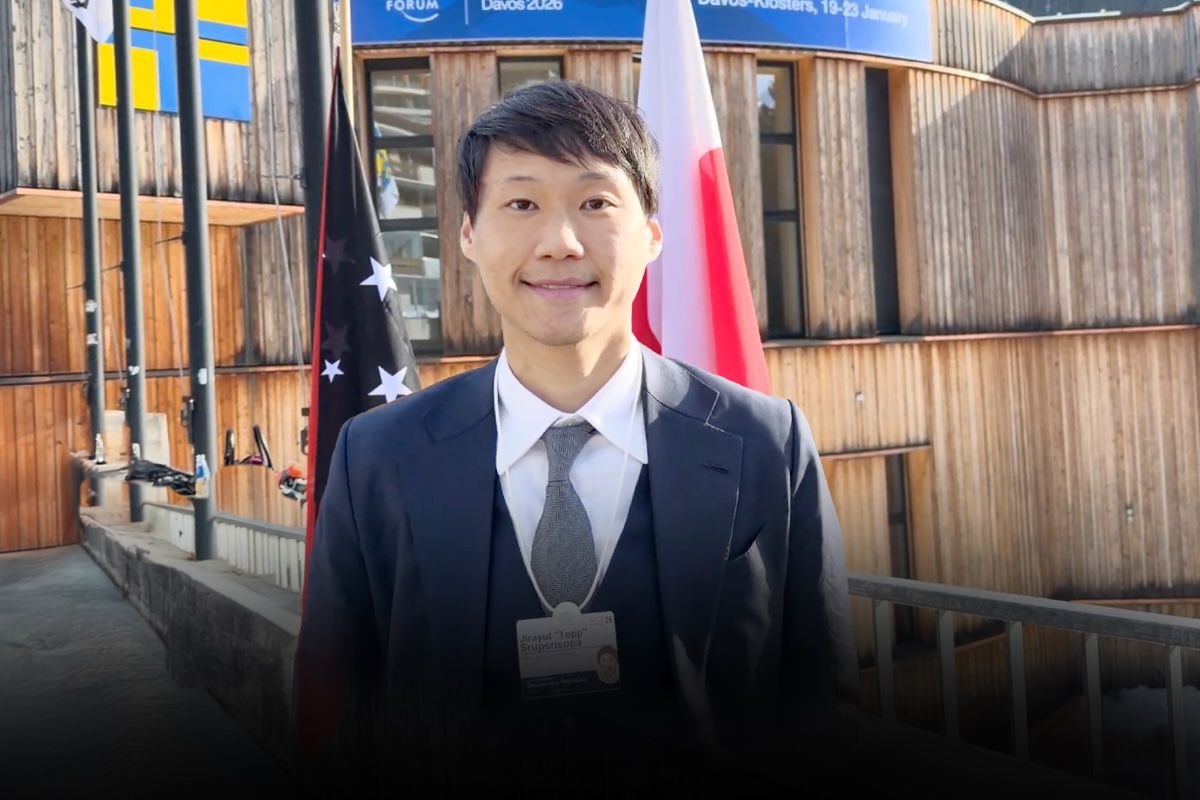
Key insights from the World Economic Forum 2026 under the theme “A Spirit of Dialogue” by Jirayut Srupsrisopa, Founder and Group CEO of Bitkub Capital Group Holdings Co., Ltd., a Thai business representative attending the World Economic Forum for the fifth consecutive year, January 19-23, 2026, in Davos, Switzerland. He emphasizes 5 key issues every Thai needs to know.
The World is Changing: From the Rule-Based Era to the Power Accumulation Era
Looking back two or three decades, the world operated under a “Rule-based Era”, an age that adhered to international norms, emphasizing trust and efficiency in trade to maximize profits. Countries with power were those with efficient trade systems and strong profitability. Today, however, those rules are being rewritten. We’re entering the “Power Accumulation Era,” where power is measured not solely by GDP figures but by the ability to control three critical resources: Energy, Food Security, and Critical Infrastructure.
This situation has prompted every nation to build “protective shields” to reduce dependence on others through investment in restructuring two key areas:
- Defense Spending: Particularly in Europe, defense budgets are exponentially increasing to build negotiating power and self-protection capabilities without relying solely on superpowers for assistance.
- Critical Infrastructure: Especially AI models, which are beginning to play crucial roles in transforming social structures, including work systems, education, and communication. Countries with human resources skilled in AI gain advantages and attract investment from around the world.
Global Trade Culture is Being Rewritten
International trade patterns are undergoing major restructuring. From the previous emphasis on globalization, where whoever had the cheapest and best products won, we’re moving toward three new concepts:
- The Transition from Globalization to Regionalization: International trade is shifting from the old globalization system that emphasized exchange efficiency toward regional-level Regionalization that prioritizes security. This is trade that no longer seeks just efficiency but looks for safety and trust between nations, choosing to trade with regional allies or groups sharing common values, such as European middle-power trade networks.
- From Dependence to Risk Distribution: Many countries worldwide are becoming aware of the risks of depending on superpowers, leading to a trend of risk distribution by seeking new business partners and allies we may not have seen before. This creates a firm standing on one’s own feet. No one wants to depend on a single superpower anymore, making multi-directional partnerships a core strategy.
- Promoting Local Consumption: Every country is trying to push domestic production as much as possible, transitioning from an era emphasizing “Supply Chain Efficiency” to one emphasizing “Supply Chain Resilience,” even if increased flexibility reduces trade efficiency.
The “5-Layer Cake” Model: Technology as National Infrastructure
In an era of the highest upfront investment in history, every country must invest in the “5-Layer Cake” for survival. It consists of the first layer, “Energy,” which is the foundation of everything; the second layer, “Computer Chips,” comparable to the brain of the digital world; the third layer, “Cloud Systems,” serving as the data hub; the fourth layer, “AI Models,” or artificial intelligence driving the future; and the top layer, “Applications Developed from AI Models,” which are channels to actual users.
But this isn’t investment that yields immediate returns. The International Monetary Fund (IMF) warns that the world may face below-benchmark growth because massive capital is being diverted to build the future. The real challenge is converting these costs into tangible profits and employment—a crucial question every country must address by trying to generate profits from these investments and finding growth opportunities through AI technology.
AI: Bubble or New Era?
Every era has technology that becomes a pivotal turning point, from the arrival of websites to smartphones, social media, and now Artificial Intelligence (AI), transforming human life at every step.
AI isn’t just changing how we work; it’s changing the entire “fabric of society”, from how we learn and communicate to economic structures and government administration. AI transforms society’s fabric by permeating daily life, economic structures, and public sector management.
But the crucial question is: this enormously important AI investment requires massive upfront capital. Many countries must borrow money to invest and attract investors. Many investors warn that this is currently like a “bubble,” with unclear profitability. Will this multi-trillion-dollar investment in AI infrastructure become a burst bubble, or will it be the beginning of a major transformation? This is the crucial question every country must answer.
The World’s New Power Map
With current geopolitics, the status of countries in the new era is clearly divided into three groups:
- Great Powers: The rule-makers. Countries with enormous power in defense, strong technology, energy advantages, food security, and technology as national infrastructure, such as the United States, China, and Russia, which control energy, technology, and military power.
- Middle Powers: The alliance-builders. Countries with regional or international-level power, such as the European Union, attempting to unite as allies to build negotiating power without depending on others. However, each country still primarily wants self-reliance.
- Small Powers: The price-takers. Countries lacking influence on the world stage, located regionally without much voice, typically having price-taker rather than price-maker status, and still lacking voice in the global arena.
Thailand’s Way Forward: 4 Critical Pillars
Finally, Topp Jirayut emphasized four critical pillars that will determine Thailand’s future in this Power Accumulation Era:
- Build Credibility and Expand Alliance Networks: Thailand must urgently build global credibility and create diverse trade partnerships, not over-depending on any single country. Don’t tie yourself too closely to any single superpower.
- Create Security and Sustainability in All Dimensions: Thailand must build security and sustainability across all dimensions, from energy and food to technology, to stand independently.
- Build Economic Flexibility: Thailand must create a flexible economy and supply chain, especially having its own 5-Layer Cake infrastructure, which requires massive investment to stand on its own feet.
- Adapt Quickly: Thailand must develop capabilities to adapt to rapidly changing global trends, because the world turns fast, and those who can’t adapt will be left behind.
“If Thailand can simultaneously drive all four factors, we won’t just survive the Power Accumulation Era, we’ll grow and become a key player in the region. We’ll be able to overcome challenges and succeed in the Power Accumulation Era where each country in the world operates through power accumulation,” Jirayut Srupsrisopa concluded.
Amid a changing world, this transformation isn’t just minor adjustments but a restructuring of the entire world order’s foundation. The question isn’t whether we’ll change, but whether we’ll change fast enough and in the right direction.
From this Davos forum, the clear message is the era of dependence and waiting has ended. The new era belongs to those who dare to invest, dare to change, and are ready to build their own power. Will Thailand choose to move forward or stand watching others pass by? The answer lies in our decisions and actions today.